



Sometimes a woman notices that her breasts sit lower than they used to, her nipples have changed position, and the upper part of her breasts seems to have lost its fullness. These changes may be especially noticeable when looking in the mirror from the side or comparing recent photographs with older ones. For some women, this happens gradually; for others, the changes become obvious within a few months. And it is not always clear whether the breasts have actually started to sag or have simply changed shape.
Even more questions arise when this happens after pregnancy or breastfeeding, in young women who have never given birth, or on only one side. A woman may be perfectly happy with her breast size but no longer recognize their former contours. Sometimes the concern is not even the change itself, but the thought that it will continue and there is nothing she can do to stop it.
How to Tell if Your Breasts Are Actually Sagging
In plastic surgery, breast sagging is called breast ptosis. But in everyday language, women use the word “sagging” to describe several different conditions. For one woman, it means her nipples have started pointing downward; for another, that her breasts have lost their upper fullness; for a third, that one breast has always sat slightly lower than the other. These changes may look similar, although anatomically they are quite different.
With true breast ptosis, the position of the breast tissue and the nipple-areola complex – the nipple and the surrounding pigmented area of skin – changes. An important anatomical landmark is the inframammary fold, the natural crease beneath the breast where it meets the chest wall. Plastic surgeons assess the degree of sagging in relation to this fold.
In clinical practice, the Regnault classification is commonly used to distinguish three grades of breast ptosis:
- Grade I – mild ptosis. The nipple is approximately level with the inframammary fold or slightly below it, but remains above the lowest point of the breast.
- Grade II – moderate ptosis. The nipple is below the inframammary fold, usually by approximately 1–3 cm, although the lower contour of the breast still extends below the nipple.
- Grade III – severe ptosis. The nipple is located at the lowest part of the breast and often points downward, while a substantial portion of the breast tissue has descended below the inframammary fold.
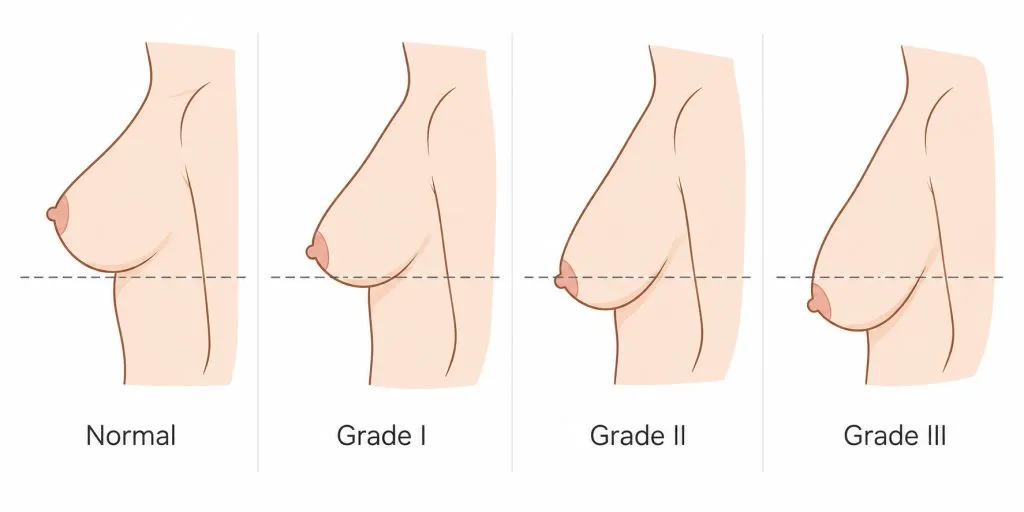
These measurements help physicians describe anatomical changes; they are not intended for self-diagnosis. In women with different breast volumes, chest wall anatomy, and inframammary fold positions, identical measurements can be associated with very different appearances.
There is another condition known as breast pseudoptosis. In this case, the nipple remains relatively high, but most of the breast tissue settles into the lower portion of the breast. The upper pole appears less full, while the lower pole becomes more prominent. A woman may see sagging breasts even though the nipple position does not meet the criteria for classic true ptosis.
Finally, there is natural variation in breast shape. Breasts do not have to be perfectly round, symmetrical, or positioned at exactly the same height. Some women naturally have more elongated breasts, a fuller lower pole, or a slight difference in nipple height. If these features have been present since breast development and are not accompanied by new changes, they do not, by themselves, indicate a medical condition or progressive sagging.
The main question, then, is not how closely the breasts match an idealized shape, but what has actually changed compared with how they looked before. This helps distinguish acquired ptosis from anatomical characteristics that have always been present.
Why Breasts Sag and Lose Their Former Shape
Breast shape depends on more than size. The amount of fatty and glandular tissue, the properties of the skin, connective tissue structures, and the distribution of volume between the upper and lower portions of the breast all play a role. These components do not change in the same way. Sometimes breast volume decreases faster than the skin contracts, sometimes the tissues gradually shift downward, and sometimes existing anatomical characteristics simply become more noticeable over time.
This is why breast ptosis can rarely be explained by a single cause – even two women of the same age and with the same breast size may experience very different changes.
How Age and Tissue Characteristics Affect Breast Shape
As we age, the skin gradually loses some of its elasticity, the properties of collagen and elastin fibers change, and breast tissues respond differently to constant mechanical stress. The glandular component of the breast may also decrease, partly because of hormonal changes, particularly during menopause. If breast volume decreases while the skin envelope retains its previous surface area, excess skin develops and the contours change.
But age does not automatically determine the degree of ptosis. One woman may maintain a relatively high breast position well into her 50s, while another experiences noticeable sagging much earlier. Inherited connective tissue characteristics, skin thickness and elasticity, and the original shape and volume of the breasts all play important roles.
Large, heavy breasts are subjected to greater continuous mechanical stress. If the supporting tissues are relatively weak or have already stretched, sagging may become more noticeable. At the same time, having small breasts does not guarantee freedom from ptosis: after losing volume, even a small breast may appear deflated and displaced downward.
Certain inherited connective tissue disorders, particularly Ehlers-Danlos syndrome, are associated with increased skin extensibility and changes in connective tissue strength. Because of these characteristics, breast tissues may be less able to withstand continuous mechanical stress, and sagging can sometimes develop earlier and become more pronounced than usual.
Why Breasts Change After Pregnancy and Breastfeeding
During pregnancy, the breasts prepare for lactation. The volume of glandular tissue increases, blood supply changes, the breasts become fuller and heavier, and the skin gradually stretches. After childbirth and the end of lactation, some of these changes reverse, but the skin and connective tissue structures do not always return to their original condition.
Women often associate breast sagging directly with breastfeeding. However, it is important to distinguish the effects of pregnancy from those of breastfeeding itself. Clinical studies have associated age, the number of pregnancies, initial breast size, elevated body mass index, and smoking with a greater likelihood of ptosis, while breastfeeding itself has not been established as an independent risk factor. This does not mean that every woman’s breasts retain their original shape after lactation. It simply means that attributing these changes entirely to breastfeeding is incorrect.
After breastfeeding ends, the breasts often become softer and smaller. The upper portion may look empty, and the skin may appear looser. It is too early to assess the final breast shape during the first few weeks after weaning, as glandular tissue volume and the overall condition of the breasts are still changing. Some women experience partial improvement in appearance over the following months, while others continue to have excess skin and sagging.
Repeated pregnancies are another consideration. Even if breast shape changed very little after the first pregnancy, that does not guarantee the same outcome after the second or third. The tissues undergo repeated changes in volume, and their ability to return to their previous dimensions varies from woman to woman.
There is no medical reason to avoid breastfeeding for the sake of preserving breast shape. Breastfeeding alone cannot predict whether ptosis will develop or how pronounced it may become.
Why Breasts Sag After Weight Loss or Weight Changes
Fatty tissue makes up a substantial portion of breast volume, although the proportion varies considerably between women. When body weight decreases, the amount of fat in the breasts may also decrease, sometimes quite noticeably. The breasts lose fullness, but previously stretched skin does not always contract enough to accommodate the reduced volume.
Changes can be particularly pronounced after substantial weight loss. A woman may go down several clothing sizes while her breasts become flatter at the top, more elongated, or develop excess skin in the lower portion. In these cases, loss of volume often occurs alongside pseudoptosis or true descent of the breast tissues.
What matters is not only how much weight was lost, but also what the breasts looked like before weight loss, how long the skin had been stretched, how quickly the weight changed, and the characteristics of the tissues themselves. This is why there is no universal amount of weight loss after which the breasts will inevitably sag.
Repeated weight fluctuations can also affect breast shape. When weight increases, breast volume expands and the skin stretches; with subsequent weight loss, the volume decreases again. If these cycles are repeated, the breasts may gradually lose their former firmness and contours.
Why Breasts May Sag at a Young Age or on Only One Side
When a girl or young woman of 16, 18, or 20 notices that her breasts sit low or have an elongated shape, it would be incorrect to attribute this to age-related ptosis. At a young age, individual breast development, inherited tissue characteristics, breast size, and congenital anatomical features are much more important considerations.
For example, in tubular breast deformity, the base of the breast may be constricted, the lower portion develops differently than usual, and the areola may appear enlarged or protruding. Such breasts are sometimes perceived as sagging, even though the underlying cause is not ordinary acquired ptosis. Other young women naturally have a more prominent lower breast pole or a low breast position on the chest wall without any underlying medical condition.
During adolescence, the breasts may still be developing, and this process is not always symmetrical: one breast may temporarily develop faster than the other in size and shape. For this reason, at 15 or 16, it is important not to jump to conclusions about established ptosis simply because the breasts do not look identical on both sides.
True ptosis is also possible between the ages of 20 and 25, particularly in women with large breasts, substantial weight changes, or certain connective tissue characteristics. But even at this age, it is important to distinguish acquired sagging from natural breast anatomy.
A situation in which one breast appears more saggy than the other deserves separate consideration. Mild asymmetry is very common: breasts may differ in volume, height, lower contour, and nipple position. If the difference has existed for a long time and remains stable, it is often simply an individual anatomical characteristic.
Can You Restore Your Breasts’ Former Shape, and What Actually Helps?
The desire to restore breast shape usually comes not from an abstract wish to change one’s appearance, but from a very specific loss of familiar proportions. A woman may miss the fullness in the upper part of her breasts, dislike the position of her nipples, or be bothered by excess skin that became noticeable after weight loss. But restoring volume, improving the appearance of the skin, and lifting descended tissues are not the same thing. Each of these concerns has different possible solutions.
Can Sagging Breasts Recover on Their Own?
Yes, partial recovery is possible, especially when the breasts have changed after pregnancy and breastfeeding. As breast volume stabilizes, the breasts may regain some fullness, and the contours of the upper and lower portions may change. However, it is not realistic to assume that they will necessarily return to their previous appearance – for some women, the changes are temporary, while for others they persist.
Some improvement in breast appearance is also possible after weight loss, particularly if the weight reduction was moderate and the skin has retained good elasticity. However, when there is substantial excess skin, natural contraction is usually insufficient to restore the former contours.
It is important to distinguish loss of fullness from true ptosis. Breast volume and contours may still change somewhat on their own, but once the nipple-areola complex has descended noticeably, it is unrealistic to expect it to return to its previous position without intervention. This is especially true of severe ptosis.
The final breast shape should not be assessed during the first few weeks after breastfeeding ends. It is reasonable to wait several months until breast volume is no longer changing noticeably. If body weight has been stable for a long time, breastfeeding ended quite some time ago, and breast shape remains unchanged, substantial spontaneous recovery is unlikely.
Do Exercises, Massage, Creams, and Supportive Bras Help?
Exercises targeting the chest muscles are beneficial for physical fitness, strength, and posture. Well-developed pectoralis major muscles can influence the overall contour of the upper chest, but the breasts themselves lie over these muscles and are not made of muscle tissue. Exercises therefore cannot reduce excess skin, move the nipples higher, or correct established ptosis.
Massage and cosmetic products may improve how the skin feels, help relieve dryness, and maintain hydration. However, there is no convincing evidence that creams, oils, body wraps, or massage can lift a descended breast. When the breasts have lost volume and excess skin folds have developed, treating only the superficial layers of the skin does not address the underlying anatomical problem.
The situation with bras is similar. A properly fitted bra supports the breasts while it is worn, reduces discomfort during movement, and can be particularly helpful for women with larger breasts. A sports bra reduces breast movement during physical activity. But once the bra is removed, the tissues return to their natural position. There is no reliable evidence that wearing a bra continuously prevents ptosis or restores lost breast shape.
Similar results should not be expected from cosmetic procedures marketed as nonsurgical breast lifts. Some technologies affect the skin and may produce limited changes in its appearance, but they cannot be considered a full substitute for surgical correction of significant breast sagging. Claims that a procedure can lift the breasts several centimeters without surgery or scars should be approached with particular caution.
Nonsurgical methods may improve comfort, skin condition, and the overall appearance of the breast area, but they cannot reliably correct established true ptosis. It is important to distinguish supportive care from an actual change in the position of breast tissues.
When Is Surgical Correction Considered to Restore Breast Shape?
If a woman’s breasts have changed shape noticeably and she is bothered by it, surgical correction may be one option. There is no automatic need for surgery based solely on the degree of ptosis: even severe breast sagging does not, by itself, require an operation if a woman is comfortable and satisfied with her appearance. Conversely, the desire to change breast shape does not necessarily have to involve severe ptosis.
For significant tissue descent, the primary surgical procedure is a breast lift, or mastopexy. During surgery, the surgeon removes the necessary amount of excess skin, reshapes and redistributes breast tissue, and moves the nipple-areola complex to a higher position. The specific technique depends on breast anatomy and the extent of the changes.
However, a breast lift alone is not intended to substantially increase breast volume. If a woman wants not only to lift her breasts but also to restore lost fullness, a combination of mastopexy and breast implants may be considered or, in selected cases, fat grafting – the transfer of the patient’s own fatty tissue. If there is sufficient natural breast volume, implants may not be needed at all.
If the breasts are large and heavy, and their volume itself causes discomfort, reduction mammoplasty may be an option – reducing breast size while simultaneously changing breast shape and position. When the main concern is insufficient volume without significant nipple descent, breast augmentation alone may sometimes be enough. However, in cases of true severe ptosis, implants alone generally cannot replace a proper breast lift.
The limitations of surgery also need to be considered. Every breast lift leaves scars, and their location and extent depend on the technique used. Surgery involves anesthesia-related and surgical risks, possible changes in nipple sensation, wound-healing problems, and other complications. The results are not permanent and unchanging either: aging, pregnancy, and weight fluctuations continue to affect breast tissues.
When considering surgery, it is therefore important to evaluate not only whether a higher breast position or greater fullness can be achieved, but also the limitations of the chosen procedure. Sometimes the desired change is relatively small, yet achieving it would require a full surgical procedure, with scars and a recovery period. That matters when making a decision.
What Can You Do to Help Preserve Breast Shape in the Future?
It is impossible to completely prevent changes in breast shape. A woman cannot control her genetic background, natural aging, or the inherent characteristics of her connective tissue. However, some factors that may contribute to additional tissue stretching and volume loss can be managed. And what matters here is not special breast treatments, but ordinary everyday habits.
First, it is advisable to maintain a relatively stable body weight and avoid repeated substantial weight fluctuations. If a woman plans to lose weight, a gradual reduction that she can maintain over time is a more reasonable approach. Even then, however, the breasts may lose some volume and change shape. There is no way to lose weight while guaranteeing that the breasts will retain their former fullness.
Another recommendation is to stop smoking. Smoking adversely affects the skin and connective tissue, and studies of breast ptosis have identified it among factors associated with a greater likelihood of breast sagging. Quitting smoking does not guarantee that breast shape will be preserved, but it removes one factor that a woman can actually control.
Women with larger breasts, particularly during physical activity, may benefit from a comfortable, supportive bra. It reduces breast movement and the associated discomfort, especially during running and other high-impact activities. However, there is no convincing evidence that even continuous use of a supportive bra prevents ptosis. A bra should therefore be chosen primarily for comfort, rather than out of fear that the breasts will inevitably sag without one.
During pregnancy and after childbirth, there is no need to try to preserve breast shape through special creams, vigorous massage, or constantly wearing tight bras. These methods have no proven preventive effectiveness. It is far more useful to take care of overall health, follow medical recommendations regarding nutrition and physical activity, and avoid rapid weight fluctuations after childbirth.
What Should You Consider Before Deciding Whether You Need Breast Correction?
A change in breast shape does not always mean that something is wrong. There is no single correct breast shape or position, and ideas about what breasts should look like are often influenced by photographs, social media, and other women’s surgical results. The first step is therefore to understand what is actually causing dissatisfaction: a real change from the breasts’ previous shape or a difference between their appearance and personal expectations.
It also matters how much these changes affect everyday life. One woman may dislike how her breasts look without a bra but feel comfortable with them and have no desire to change anything. For another, losing her former breast shape may become a persistent source of dissatisfaction with her appearance. Both responses are entirely normal, and the degree of ptosis alone does not determine whether correction is necessary.
If the desire to change breast shape persists, realistic expectations are important. Surgical correction can significantly change breast position and contours, but it cannot return tissues to exactly the condition they were in many years ago or guarantee that the result will remain unchanged for life. The decision should therefore take into account not only the desired improvements, but also how important they are to the woman personally and whether she is willing to accept the limitations of surgery to achieve them.

Clinical Guidelines and References
- Regnault P. Breast Ptosis. Definition and Treatment. Clinics in Plastic Surgery, 1976. The original classification of breast ptosis, distinguishing true ptosis, partial ptosis, and pseudoptosis.
- Rinker B., Veneracion M., Walsh C. P. Breast Ptosis: Causes and Cure. Annals of Plastic Surgery, 2010. A clinical study of factors associated with breast sagging, including age, weight changes, pregnancies, breast size, and smoking.
- Rinker B., Veneracion M., Walsh C. P. The Effect of Breastfeeding on Breast Aesthetics. Aesthetic Surgery Journal, 2008. A study examining the effects of pregnancy and breastfeeding on breast shape, which did not identify breastfeeding as an independent risk factor for ptosis.
- Breast Lift with and without Implant: A Synopsis and Primer for the Plastic Surgeon. Plastic and Reconstructive Surgery – Global Open, 2020. A professional review of breast ptosis classification, mastopexy techniques, breast lift combined with augmentation, and the limitations of surgical correction.
- American Society of Plastic Surgeons (ASPS). Breast Lift Risks and Safety. Professional information on mastopexy, surgical risks, scarring, changes in sensation, and potential complications.