


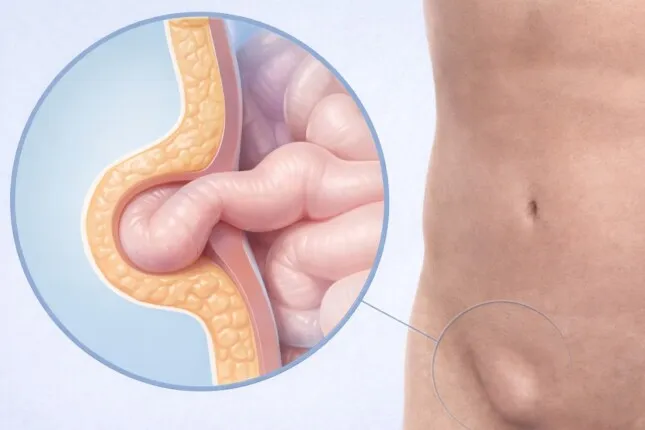
An inguinal hernia almost never begins with a dramatic story. Usually everything looks fairly harmless: a small bulge in the groin, a feeling of heaviness by the evening, sometimes mild discomfort after physical exertion. A person notices it, checks with the hand, observes for a few days and decides that it was probably just a strained muscle or fatigue. After some time the bulge may decrease or even disappear when lying down – and this finally reassures the person.
In surgery there is one rule that almost never fails: if a defect has appeared in the abdominal wall, it does not disappear on its own. A hernia may behave quietly for some time. It may hardly interfere at all. It may even create the illusion that everything is under control. But the opening in the tissues remains. And gradually becomes larger.
In consultation this story sounds surprisingly often. A person comes and says: “Doctor, I’ve had it for a long time… it just didn’t bother me before.” Sometimes this is a calm planned situation. But sometimes behind this phrase there is already an incarcerated hernia and an urgent operation.
Therefore the first thing to understand: an inguinal hernia is not temporary discomfort and not a “stretched muscle.” It is an anatomical defect. And it is better to deal with it calmly while the situation remains planned.
But without self-deception.
What You Need to Know About an Inguinal Hernia
When a person first hears the diagnosis “inguinal hernia,” there is often a slight confusion. On the one hand, it sounds serious. On the other hand, many acquaintances say that “some people live with a hernia for years and nothing happens.” The truth, as often happens in medicine, lies somewhere between these extremes.
To calmly understand the situation, it is important to grasp several basic things: what exactly is happening in the body, what types of inguinal hernias exist, and why this particular area becomes a weak point of the abdominal wall.
What Is an Inguinal Hernia
Put simply, an inguinal hernia is a situation where part of the contents of the abdominal cavity begins to protrude through a weak spot in the abdominal wall in the area of the inguinal canal. Most often this is a loop of intestine or omentum. From the outside it appears as a soft bulge in the groin that enlarges with coughing, straining, or physical exertion.
Sometimes the hernia is noticeable only when standing. Sometimes it appears after exertion and almost disappears when a person lies down. This is why many people do not pay much attention to it for a long time – it seems that the problem “comes and goes.”
But there is an important point. The bulge may disappear. The defect does not.
That is the whole point.
Main Anatomical Differences
Inguinal hernias may differ in anatomy. Most often they are described as direct and indirect hernias – the difference depends on the path the hernia sac takes through the structures of the groin region. An indirect hernia follows the natural course of the inguinal canal. A direct hernia emerges through a weakened area of the abdominal wall next to it.
Hernias may also be reducible or non-reducible. A reducible hernia can temporarily decrease when the organs return back into the abdominal cavity. A non-reducible hernia remains outside constantly and behaves less predictably.
For the patient these differences are not always essential.
For the surgeon – they are.
How an Inguinal Hernia Forms
When we talk about an inguinal hernia, it is important to understand one thing: it does not appear by chance and it does not develop “in a single day.” In most cases this is a process that develops gradually. A person may not notice any changes for a long time until one day a small bulge or a strange sensation in the groin area becomes noticeable.
But behind this moment there is usually a chain of causes and conditions that have been forming for some time.
Let’s take a closer look.
Mechanism of Inguinal Hernia Formation
The anterior abdominal wall is not completely solid. There are natural areas where the tissues are thinner – vessels, nerves, and anatomical canals pass through them. The inguinal canal is one of these areas. In men the spermatic cord passes through it, which makes the canal wider and more vulnerable. In women it is narrower but still remains a weak point. When pressure from inside repeatedly acts on this area – during exertion, coughing, or straining – the tissues gradually stretch.
The connective tissue begins to tear, the opening gradually widens, and organs are pushed outward.
At first this is almost invisible from the outside. Then a small bulge appears. Over time the bulge increases.
This is how a hernia gradually forms.
Who Is More Likely to Develop an Inguinal Hernia
Inguinal hernias occur much more often in men. The reason has already been mentioned above – the anatomy of the inguinal canal. But this does not mean that women do not encounter hernias. This is especially true after pregnancy, with significant physical strain, or with pronounced connective tissue weakness.
There are other risk groups as well: people whose work involves regular heavy lifting, patients with chronic cough, constipation, or excess body weight.
Combinations of factors are the most common.
Why Hernias Do Not Develop in Everyone
This is a question patients ask very often: why does one person develop a hernia while another does not, even if the physical strain is similar.
The answer usually lies in the condition of connective tissue. In some people it is denser and stronger, in others more elastic and stretchable. If the tissues are initially weaker, even normal loads can eventually lead to the formation of a defect.
This is an individual characteristic.
Main Factors That Trigger Hernia Development
A hernia most often develops in situations where intra-abdominal pressure regularly increases: heavy physical work, intense physical strain, chronic cough, or constipation with straining. Sometimes a single strong episode of strain may be enough.
But more often the process develops gradually.
Factors That Create Conditions for Hernia Formation
There are also factors that do not directly cause a hernia but weaken the tissues: age-related changes, hereditary characteristics of connective tissue, scars after surgery, and injuries of the abdominal wall.
When such factors combine with physical strain, the risk of hernia formation becomes significantly higher.
How an Inguinal Hernia Usually Presents
An inguinal hernia rarely remains completely unnoticed. Usually the body still sends signals. It is important to recognize them.
How an Inguinal Hernia Looks in Men and Women
The most characteristic sign is a bulge in the groin area. It may be small or quite pronounced. It often increases with coughing, straining, or lifting heavy objects. When lying down, the bulge may decrease or disappear.
This is the typical picture.
There is another characteristic sign. If you place your palm over the bulge and cough, you may feel a slight impulse from inside. For a surgeon this is one of the typical signs of an inguinal hernia.
What Sensations an Inguinal Hernia Causes
Besides the visible sign, patients often describe a feeling of heaviness, pressure, or pulling pain in the groin. Sometimes discomfort appears during prolonged walking, physical strain, or coughing.
Sometimes the hernia hardly hurts at all.
This is exactly why it is often underestimated.
How an Inguinal Hernia Differs from Other Conditions
A groin bulge does not always mean a hernia. Lymph nodes may enlarge in this area, lipomas, cysts, or inflammatory infiltrates may form. In women, groin pain may be related to gynecological causes.
A clinical examination helps distinguish a hernia by its change with physical strain and body position. In doubtful cases ultrasound of the groin area is helpful.
This is why self-diagnosis is often incorrect.
Why an Inguinal Hernia Cannot Be Treated Without Surgery
This is one of the most common questions patients ask. People look for ways to avoid surgery. This is natural. But in the case of a hernia it is important to understand the mechanics of the process.
Consequences and Risks if a Hernia Is Not Treated
Over time the hernia opening enlarges. The bulge becomes bigger.
The main risk is incarceration. This is a condition where the contents of the hernia sac become trapped in the hernia opening. Blood supply to the tissues is disrupted, severe pain develops, and intestinal obstruction may occur.
This becomes emergency surgery.
And a completely different situation.
Another important point is the gradual enlargement of the defect. Over time the hernia becomes larger and surgical treatment becomes technically more complex. Planned surgery is almost always safer and more predictable than emergency surgery.
Why Braces and Other Methods Do Not Treat a Hernia
A brace may temporarily support the hernia and reduce discomfort. But it does not eliminate the defect of the abdominal wall itself. The opening in the tissues remains.
Therefore a brace can only temporarily hold the hernia.
But it does not treat it.
Why Folk Remedies Do Not Treat an Inguinal Hernia
Sometimes patients ask about compresses, ointments, or traditional remedies. But a hernia is an anatomical defect. It cannot be closed with external remedies.
A hernia is an opening in the tissues.
It is physically impossible to close it with compresses.
Can You Live with an Inguinal Hernia
Some people indeed live with a hernia for a long time without serious complications. But it is impossible to predict when the situation may change.
The risk remains.
When Surgery Should Not Be Postponed
If the hernia is still small and does not cause significant pain, until a surgeon’s consultation it is usually enough to follow simple measures: avoid heavy lifting, avoid strong straining, and carefully monitor changes in the bulge.
If the bulge becomes firm and painful, stops decreasing when lying down, and sharp pain, nausea, or worsening of general condition appear – this may indicate incarceration. In such a situation, urgent medical care is required.
Sometimes the timeframe is measured in hours.
Which Doctor to See
If an inguinal hernia is suspected, the first specialist should be a surgeon. It is the surgeon who determines the type of hernia, assesses tissue condition and risks, and selects the further strategy. A surgeon’s consultation is not a commitment to immediate surgery, but a way to gain clarity and make a balanced decision.
How the Doctor Confirms the Diagnosis
In most cases, I identify an inguinal hernia already during the examination. It is one of those conditions that an experienced surgeon recognizes immediately. I assess the location of the bulge, ask the patient to cough, and observe how it changes with abdominal muscle straining. These signs provide a great deal of information.
In typical cases, this examination is already sufficient to make the diagnosis.
I order an ultrasound examination not because it is impossible to make the diagnosis without it. Most often the diagnosis is already clear. But ultrasound helps уточнить details: the size of the hernia defect, the contents of the hernia sac, and the condition of the surrounding tissues. This is useful when it is necessary to calmly assess the situation and discuss the next steps.
This is usually enough.
I order computed tomography for an inguinal hernia extremely rarely. Over decades of practice, such situations can be counted on one hand. Usually this is an atypical clinical picture or suspicion of another disease.
How to Choose the Right Medical Center and Doctor
Choosing the right doctor for an inguinal hernia is crucial for the outcome of treatment: even the same operation can produce different results – everything depends on who performs it.
For inguinal hernias, I recommend seeing an abdominal surgeon who has experience specifically in operations on the abdominal wall. More precisely – a hernia specialist, a surgeon who deals exclusively with hernias: inguinal, umbilical, incisional. Such a doctor knows the anatomical nuances well, is familiar with modern mesh fixation techniques, masters minimally invasive (laparoscopic) approaches, and can choose the optimal option for your specific case.
When choosing a clinic, pay attention not only to advertising, but also to the institution’s reputation, patient reviews, and the level of operating room equipment. It is good if the center can provide full diagnostics, consultations with related specialists, and postoperative follow-up in comfortable conditions.
Do not hesitate to ask the doctor specific questions about the technique, risks, and recovery. Calm and clear answers are one of the signs of a professional approach.
How Inguinal Hernia Repair Is Performed
Today hernia surgery is a well-established field of medicine. The procedure is performed quickly, safely, and with minimal discomfort for the patient. The choice of method depends on the type of hernia, its size, the patient’s age, and overall health.
The Essence of the Procedure, Preparation, and Surgical Methods
The essence of the procedure is simple: return the organs to the abdominal cavity and reinforce the weak area with a special mesh. This mesh becomes a framework for the tissues and over time almost completely integrates into the abdominal wall.
Before the procedure it is important to undergo evaluation: ultrasound, blood tests, and a consultation with a primary care physician or cardiologist – to ensure the body is ready for anesthesia and recovery. The doctor explains how the operation will proceed, possible anesthesia options, and the length of hospital stay. The day before the procedure it is advisable to follow a light diet and avoid physical strain. A well-prepared patient is already half the success.
The traditional open repair method has been used for more than two centuries and remains a reliable option. Through a small incision in the groin area, the surgeon returns the organs to their place and reinforces the weak point with a special mesh that prevents recurrence. Modern materials do not cause rejection, integrate well, and the operation itself lasts about 30–40 minutes. The advantage of the method is the ability to clearly see the anatomical structures, which is especially important for large hernias.
Laparoscopic inguinal hernia repair is a more modern, minimally invasive technique. Instead of one large incision, several small punctures are made through which instruments and a camera are inserted. The surgeon performs all manipulations inside while monitoring the process on a screen. This approach provides minimal pain, no large scars, and a quick return to normal life – often within a few days. Laparoscopy is especially effective for bilateral hernias or recurrences after previous surgery.
In modern surgery both methods – open and laparoscopic – have their advantages. The main task of the doctor is to choose the optimal option specifically for you, taking into account all individual characteristics. With the right approach the result is always the same – life without pain, limitations, or fear of recurrence.
This is the basis of treatment.
Rehabilitation After Surgery
Recovery after inguinal hernia surgery is usually easy if the patient follows the doctor’s recommendations. Within a few hours after the procedure the patient can already get out of bed, and most people return to their usual lifestyle within 1–2 weeks. The key is not to rush and to allow the body time to heal.
During the first days a slight feeling of tension or mild discomfort in the incision area is possible – this is a normal tissue reaction. It is important to avoid heavy lifting, sudden movements, and severe coughing. If a mesh has been placed, it gradually integrates into the tissues, creating a strong support.
This reduces the risk of recurrence.
Prevention and Risk of Hernia Recurrence
Preventing the development of an inguinal hernia is quite possible if you understand the main risks and follow several simple rules.
First of all – avoid excessive physical strain, especially without proper preparation. Lifting heavy objects without abdominal muscle support creates a sudden increase in intra-abdominal pressure, which may trigger hernia formation.
The condition of the digestive system also plays a major role. Chronic constipation or persistent coughing are factors that increase intra-abdominal pressure. Monitor your diet, drink enough water, and avoid excessive alcohol and nicotine consumption.
Moderate physical exercise strengthens the abdominal wall, improves circulation, and helps prevent recurrence.
Myths About Inguinal Hernia
There are many persistent myths surrounding inguinal hernia. Some of them prevent people from seeking medical help in time.
A Hernia Can Disappear on Its Own
No. A hernia does not disappear without surgery. Even if the bulge temporarily decreases, the opening in the abdominal wall remains. In consultation I often hear that “it became smaller – so it’s going away,” but anatomically this is only temporary relief, not a solution to the problem.
If It Does Not Hurt, It Does Not Need Treatment
Hernia incarceration is an emergency condition that can threaten life, so timely treatment is critically important. In clinical practice this risk most often becomes the reason for emergency operations that could have been avoided with planned treatment.
Inguinal Hernia Occurs Only in Older People
Hernias occur in all age groups – from children to adults, in both men and women. In practice it is common to see patients of working age who are genuinely surprised by the diagnosis, considering it an “age-related problem.”
A Belt (Brace) or Special Exercises Eliminate the Hernia
They may temporarily relieve discomfort but do not eliminate the defect. Medical experience shows that prolonged use of a brace without proper observation often only delays treatment and leads to enlargement of the hernia.
Surgery Is Always Painful and Recovery Is Long
Modern minimally invasive techniques (laparoscopy, buried sutures) help minimize pain and allow rapid recovery. With the correct choice of method, patients often return to normal activity much sooner than they expect.
Conclusion
An inguinal hernia is not a mysterious disease and not a rare surgical condition. Its mechanism is well understood, its signs are quite characteristic, and treatment methods have long been established and provide predictable results.
Difficulties usually arise not because of the hernia itself, but because of waiting. When the bulge is small and causes little discomfort, it is easy to believe that the situation does not require attention. But anatomically the abdominal wall defect already exists – and over time it only becomes larger.
That is why a calm, planned strategy is always more reliable than waiting for complications.
A hernia does not disappear on its own.
But it is successfully treated – if the problem is addressed in time.


Clinical Guidelines and Sources
- HerniaSurge Group. International Guidelines for Groin Hernia Management. Hernia. 2018.
- Stabilini C. et al. Update of the International HerniaSurge Guidelines for Groin Hernia Management. BJS Open. 2023.
- European Hernia Society (EHS). Guidelines for Groin Hernia Management.
- NICE. Laparoscopic Surgery for Inguinal Hernia Repair. TA83.
