



When someone says, “My kidneys hurt,” they usually mean pain somewhere in the lower back, closer to the right or left side. Sometimes it starts suddenly and makes it almost impossible to sit still. Sometimes it feels like a dull pulling sensation that lasts for days, especially after sleeping or physical activity. And sometimes the pain is quite mild, but the concern is serious: what if something is wrong with the kidneys?
The problem is that the location of pain alone cannot tell us where it comes from. The kidneys are located near the spine and back muscles, and some conditions affecting internal organs can also cause pain that radiates to this area. Conversely, genuine kidney pain is sometimes felt somewhere entirely unexpected, such as the abdomen or groin.
So the first question should not be “Which kidney hurts?” but rather where exactly the pain started, how it behaves, and what other changes appeared along with it. These details often tell a doctor much more than the complaint of “kidney pain” itself.
Where Kidney Pain Is Felt and How to Tell It Apart From Back Pain
The kidneys are located toward the back of the abdominal cavity, on either side of the spine, approximately at the level of the lower thoracic and upper lumbar vertebrae. The right kidney is usually positioned slightly lower than the left. Much of each kidney is protected by the lower ribs, so looking for them near the pelvis, at the bottom of the lower back, is a mistake. They are located higher.
If pain truly comes from a kidney or the upper urinary tract, it is most often felt to one side of the spine, beneath the lower ribs, and may extend around the side of the abdomen. But this is only an anatomical reference point, not a way to make a diagnosis.
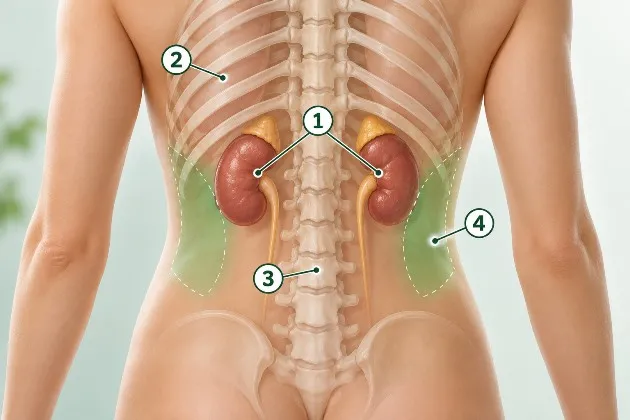
- Kidneys
- Lower ribs
- Spine
- Side regions of the lower back – areas where pain originating from the kidneys may be felt.
There is an important detail: kidney tissue itself is relatively insensitive to pain, unlike the skin or muscles. Pain usually develops when the kidney capsule stretches, pressure increases in the urine-collecting system, surrounding tissues become irritated, or certain other processes occur. This is why kidney disease does not necessarily cause pain. For example, many chronic conditions that impair kidney function develop for a long time without causing any pain at all.
Muscles, ligaments, joints, and the spine, on the other hand, are much more common sources of pain. If lower back pain appears after strenuous work or sleeping in an awkward position and becomes worse when bending, turning your torso, getting up from a chair, or tightening certain muscles, the source is most likely in those structures. Sometimes you can even pinpoint a tender spot.
Kidney pain is usually less dependent on body position. During renal colic, for example, a person may keep changing positions, not because a particular movement makes the pain worse, but because no position provides relief. That is a fairly characteristic difference.
However, it should not be turned into a do-it-yourself diagnostic test. Pain caused by spinal conditions can also be severe and constant, and someone with kidney disease can have muscle pain at the same time.
There are other clues as well. Fever, chills, blood in the urine, painful or frequent urination, and nausea accompanying severe flank pain make a urinary tract cause more likely. But the absence of these signs does not necessarily mean that the kidneys and ureters are fine.
If the source of the pain is unclear, a reasonable starting point is an examination by a primary care physician. Signs of kidney or urinary tract disease may require a urologist, while impaired kidney function sometimes calls for a nephrologist. And if the pain is sudden, severe, or accompanied by a significant deterioration in your condition, do not waste time trying to decide which specialist you need. Getting medical attention promptly matters more.
How Kidney Pain Feels With Different Diseases and Conditions
There is one principle I explain to patients all the time: the intensity of pain and the seriousness of a disease are two different things. A small stone can cause an excruciating attack, while moderate pain sometimes accompanies a condition that requires substantial treatment.
That is why it makes sense to look at the most characteristic patterns of pain together with other symptoms, rather than focusing on individual diagnoses. These are what people experience first, before they even know what is causing the problem.
Sharp, Severe Pain in the Kidney Area
Imagine this: everything was fine just half an hour ago, and now your side or lower back suddenly hurts. The pain intensifies quickly, becoming so severe that you cannot sit or lie still. It may spread down the side of the abdomen toward the groin and, in men, into the testicle. Nausea, vomiting, and cold sweats are also common.
This pattern immediately raises suspicion of renal colic. Most often, it is caused by a stone that has left the kidney and entered the ureter.
The mechanism is fairly straightforward. The kidney continues producing urine, but the stone prevents the ureter from carrying it normally. Pressure builds up above the obstruction, the walls of the urinary tract stretch, and intense pain signals develop. The ureter contracts in an attempt to move urine forward, but as long as the stone blocks the passage, normal drainage cannot occur.
And here is what matters: stone size does not always correspond to pain intensity. A tiny calculus (stone) lodged in a narrow section of the ureter can cause an extremely painful attack. Meanwhile, a larger stone sitting quietly inside the kidney without obstructing urine flow may cause no symptoms whatsoever.
Pain during renal colic often comes in waves. It eases for a while, then hits again. Sometimes its location changes as the stone moves. But assuming that pain moving downward means the stone is almost out would be a mistake. You cannot reliably determine a stone’s position from how the pain feels.
We discuss how these attacks develop and the risks involved in a separate article on renal colic.
But not every sudden episode of flank pain is renal colic. Acute abdominal conditions can produce a similar picture, as can vascular disorders in much rarer cases, including impaired blood supply to the kidney. That is why severe pain occurring for the first time should never automatically be blamed on kidney stones, even if stones have been found before.
If the pain starts suddenly, is extremely intense, does not improve, or is accompanied by repeated vomiting, urgent medical evaluation is necessary. Pain accompanied by an inability to urinate or a sharp decrease in urine output is particularly concerning. Medical attention should also not be delayed during pregnancy or in someone with only one functioning kidney.
Dull, Aching, or Pulling Pain in the Kidney Area
This complaint is more complicated. Someone may feel heaviness beneath the ribs toward the back, an occasional pulling sensation, or persistent moderate pain for weeks. There is no dramatic attack like renal colic. You can work, you can walk, and sometimes you even manage to forget about the discomfort. But it keeps coming back.
The first thing to understand is that dull pain in this area very often has nothing to do with the kidneys. The cause may lie in the muscles, spinal joints, or nerves. But stopping at that explanation alone can mean overlooking conditions in which the pain really does result from changes in the kidney.
And there are several characteristic situations.
For example, when urine cannot drain properly from a kidney, its collecting system may gradually become enlarged. This condition is called hydronephrosis. If pressure increases slowly, the pain may remain moderate and feel more like fullness or heaviness. Sometimes there is no pain at all, even when the changes are quite pronounced.
Some large kidney cysts can cause pain if they stretch the kidney capsule or press on nearby structures. A small, simple cyst discovered incidentally on ultrasound usually does not hurt. So finding a cyst and immediately declaring it the cause of months of lower back pain is an overly simple conclusion, and often the wrong one.
Sometimes a patient arrives with an ultrasound report mentioning “microliths,” “sand,” or “small calculi” and considers the question settled. So that must be why the back aches. But the mere presence of small deposits in the kidney does not prove that they are causing the pain. We need to understand whether there is impaired urine drainage, inflammation, or another change that could explain the symptoms.
I also want to say something about chronic kidney disease. There is a widespread belief that the kidneys must start “aching” when they begin to function poorly. No. Many conditions that gradually reduce kidney function do not cause characteristic lower back pain. You cannot assess them by how you feel.
That is why the biggest mistake with persistent dull pain is spending months treating supposedly “bad kidneys” simply because the discomfort happens to be in approximately the right place. If the pain persists or returns, its source needs to be identified, even when it is quite tolerable.
Kidney Area Pain With Fever and Chills
This is a different clinical situation. If flank or lower back pain is accompanied by a high fever, chills, pronounced weakness, and sometimes nausea or vomiting, one of the first things to rule out is a kidney infection, specifically acute pyelonephritis.
In pyelonephritis, inflammation affects the kidney tissue and its collecting system. The pain is usually constant, dull, or fairly intense and may be felt on one or both sides. Unlike renal colic, it generally does not produce the typical waves of sharp pain radiating toward the groin.
Sometimes a patient says that frequent urges to urinate and burning during urination started several days earlier, followed by fever and lower back pain. This sequence is indeed characteristic of an infection that has spread upward from the lower urinary tract.
But there is an unpleasant detail: pyelonephritis can also develop without noticeable urinary symptoms. So the reasoning “there is no burning, therefore it definitely isn’t my kidneys” does not work here.
The situation is particularly dangerous when an infection develops behind an obstruction to urine flow. For example, a stone blocks the ureter while an infection develops above it. In that situation, simply taking an antibiotic and waiting for the fever to subside is not enough. If infected urine cannot drain properly, urgent drainage may be required in a hospital.
At that point, we are talking about the risk of a severe infection and sepsis, not an ordinary case of lower back pain.
Kidney area pain accompanied by fever and chills requires urgent medical attention on the same day. If the condition deteriorates rapidly, confusion develops, weakness becomes severe, blood pressure drops, or urination becomes impaired, emergency care is necessary. Do not try to choose an antibiotic from your medicine cabinet or apply heat to your lower back in the hope that the inflammation will go away.
One more point. If someone is convinced they “caught a chill in their kidneys” because they were cold the day before, that is not a diagnosis. Exposure to cold alone does not explain the development of a bacterial kidney infection. When pain and fever occur together, the cause needs to be investigated medically, not by trying to remember where you sat on a cold surface.
Intermittent Pain in the Kidney Area
Here, patients usually describe not so much what the pain feels like, but how it behaves: it hurts and then stops, returns a few days later, and then fades again. Sometimes a person feels completely healthy between episodes.
This pattern does occur with urinary tract conditions, but it is not a specific sign of a kidney problem.
One possible mechanism is intermittent obstruction of urine flow. For example, the obstruction may be partial, and the degree of blockage may change depending on the stone’s position, ureteral activity, and the amount of urine being produced. Pressure rises, and pain develops. Pressure falls, and the pain eases.
Certain anatomical variations where the renal pelvis connects to the ureter can also cause episodic pain, sometimes after increased fluid intake. But such causes cannot be confidently identified from symptoms alone.
Much more often, recurring lower back discomfort has a musculoskeletal origin. This is especially true when episodes follow similar physical activities, long drives, working in a bent position, or exercise.
And here is the trap. People think that if a disease is serious, the pain must keep getting worse. If it does not hurt today, there must be nothing dangerous going on.
Unfortunately, that is not always true. When urine drainage is impaired, a reduction in pain does not prove that the obstruction has disappeared. In some conditions, pressure inside the kidney remains elevated even after the severe pain has subsided.
That is why recurring pain, particularly on one side, should not be judged solely by how well you feel between episodes. If it keeps returning without an obvious connection to movement or physical activity, the cause needs to be investigated rather than waiting for another attack.
What to Do if Your Kidneys Hurt – How to Relieve Pain and What to Avoid
The first instinct when pain strikes is understandable: take a painkiller, apply a heating pad, drink more water, and wait for it to pass. Sometimes these measures really do make you feel better. But the problem is that different causes of pain require very different approaches.
So the first step is not to search for a universal “kidney remedy,” but to assess your condition. If the pain is very severe, starts suddenly, or is accompanied by fever, chills, repeated vomiting, an inability to urinate, or a noticeable decline in your general condition, home treatment is not appropriate. These situations require urgent medical evaluation.
If the pain is moderate, your condition is stable, and there are no signs of an acute illness, a few simple measures may help you feel more comfortable until you see a doctor. But they should not be mistaken for treatment of a kidney condition.
- Give yourself a chance to rest.
Temporarily avoid strenuous physical work, workouts, and heavy lifting. If the pain comes from overworked back muscles, reducing the strain often brings noticeable relief. But there is no need to lie motionless all day either. Gentle walking and normal movement are perfectly reasonable if you can tolerate them. - Try to find a comfortable position.
You can lie on your side with your knees slightly bent or on your back with a pillow beneath your knees. With muscular pain, these positions sometimes reduce tension and discomfort. But if you keep changing positions and nothing helps, do not spend hours searching for the “right” position. - Maintain your usual fluid intake.
If you have no fluid restrictions, drink water in small amounts according to your thirst. There is no need to deliberately increase your intake to “flush out your kidneys.” If urine drainage is obstructed, forcing yourself to drink several liters of water may make the pain worse. - Use pain relievers with their contraindications in mind.
Nonsteroidal anti-inflammatory drugs are indeed considered first-line treatment for renal colic, but they may be contraindicated in people with impaired kidney function, dehydration, peptic ulcer disease, certain cardiovascular conditions, or during pregnancy. For pain of unknown origin, acetaminophen may sometimes provide short-term relief if there are no contraindications, particularly serious liver disease. Do not combine several pain relievers at random or exceed the doses stated on the label. - Pay attention to changes in how you feel.
Notice exactly where the pain is, whether it is becoming stronger, whether its character is changing, and whether fever, nausea, or urinary problems have appeared. These details will help your doctor identify the cause.
There are also things you should avoid. Do not apply heat to your lower back when the cause of the pain is unknown, especially if you have a fever or a suspected infection. Do not start taking diuretics or herbal remedies on your own. Antibiotics are not painkillers either.
If your doctor has already prescribed a pain management plan for previously diagnosed kidney stone disease, follow those instructions. But a new attack should not automatically be treated as an exact repeat of the previous one, especially if the nature of the pain, your overall condition, or urination has changed.
I also want to address the common advice to “jump around to make the stone come out.” If you do not even know whether you have a stone, such experiments make no sense. And if a stone really is in the ureter, its movement depends on its size, location, the condition of the ureter, and other factors. A few jumps will not turn a complicated anatomical situation into a simple mechanical problem.
Frequently Asked Questions About Kidney Pain
Can Only One Kidney Hurt, or Can Both Hurt at the Same Time?
Yes, pain originating from the kidneys can affect one or both sides. When a stone obstructs urine drainage from one kidney, pain usually occurs on that side. With an infection, pain may occur on either side or both, although one-sided involvement is quite common.
But symmetrical lower back pain does not necessarily mean that both kidneys are affected. Pain involving muscles on both sides of the back is much more common than many people realize. Conversely, pain on one side does not prove that the problem is in the right or left kidney.
Why Does My Kidney Hurt if My Urine and Blood Tests Are Normal?
Because laboratory tests cannot answer every question. A urinalysis can detect signs of inflammation, blood, and certain other abnormalities, but it does not show whether urine is flowing freely through the ureter. For example, blood in the urine is common with a ureteral stone, but its absence does not rule out a stone.
Blood tests tell a similar story. A normal creatinine level indicates that overall kidney filtration function is preserved at the time of testing, but it does not guarantee normal urine drainage on both sides. If one kidney is functioning normally, blood test results may remain within the normal range even when there is a problem with the other kidney.
There is another possible explanation: the source of the pain may have nothing to do with the urinary system at all.
So if the pain persists despite normal test results, there is no point in repeatedly taking the same tests in the hope that an abnormality will finally appear. The pain itself and the results already obtained need to be assessed. If a stone or impaired urine drainage is suspected, the doctor will determine whether an ultrasound or another imaging study is needed. If no urologic cause is found, the search will turn to other organs and tissues.
Why Do My Kidneys Hurt After Drinking Alcohol?
Not every episode of lower back pain after drinking alcohol is related to the kidneys. Dehydration, muscle tension, an awkward sleeping position, and other circumstances that happen to coincide with alcohol consumption may be responsible.
Alcohol can increase urine production and contribute to fluid loss. In someone with an existing urinary tract problem, changes in fluid balance may sometimes be accompanied by discomfort. But this symptom alone cannot establish whether a stone is present or kidney function is impaired.
If the pain regularly appears after alcohol, especially on one side, do not explain it by saying that your kidneys supposedly “cannot handle the workload.” That everyday expression tells us nothing about the actual cause. Repeated episodes deserve evaluation regardless of which drink preceded them.
Can Antibiotics or Other Medications Cause Kidney Pain?
Some medications can indeed damage the kidneys. These include certain antibiotics, nonsteroidal anti-inflammatory drugs, and several other medications, particularly at certain doses, with prolonged use, during dehydration, or when kidney function is already reduced.
But medication-related kidney injury often causes no pain at all. It may show up as changes in blood test results, urine output, or other findings. Therefore, lower back pain after starting an antibiotic does not, by itself, prove that the medication has damaged the kidneys.
There is another possibility: someone is taking an antibiotic for a urinary tract infection, but the pain comes from the infection itself, its progression, or impaired urine drainage rather than from the medication.
If pain develops during treatment, especially along with reduced urine output, swelling, fever, or worsening general health, contact the doctor who prescribed the medication. Severe symptoms require urgent evaluation. Do not independently switch to another antibiotic or add products marketed as “kidney protection.”
What Does It Mean if Kidney Area Pain Goes Away on Its Own?
Sometimes it really does mean that the cause was temporary. For example, muscular pain may improve after rest, or a small stone may pass out of the ureter and stop obstructing urine flow.
But the disappearance of pain proves neither of these things.
During renal colic, pain may subside as spasms decrease or pressure in the urinary tract changes, even though the stone remains in place. With intermittent obstruction, there may be long periods without pain. And if a disease caused few noticeable symptoms in the first place, feeling well tells us practically nothing about the condition of the kidneys.
If it was a brief episode following obvious physical exertion and the pain has completely resolved, the situation is generally less concerning. But if the pain was very severe, accompanied by changes in urination, or keeps recurring, its disappearance should not be the only reason to skip an evaluation.
What Is Important to Understand About Kidney Pain
Kidney area pain is one of those complaints where it is very easy to make a mistake in either direction. You can spend years mistaking ordinary muscle pain for a sign of kidney disease, taking unnecessary medications, and looking for a problem where none exists. Or you can experience several severe attacks, wait until the pain eases, and decide that everything is fine, even though the cause has not gone away.
In urology, we do not judge the condition of the kidneys by how badly someone’s lower back hurts. Severe pain does not necessarily mean serious damage, and the absence of pain does not guarantee healthy kidneys. What matters much more is understanding the mechanism behind the symptoms: whether the pain really originates in the urinary system, whether urine drainage is impaired, and whether inflammation or other changes requiring treatment are present.
So my advice is simple: do not try at all costs to convince yourself that your kidneys are the source of the pain. Try to find out where the pain is actually coming from. Those are two very different tasks. And only the second one helps you make the right decision.
The main thing to understand is that relieving pain and eliminating its cause are not the same thing. If the discomfort persists, returns, or becomes more severe, do not spend weeks experimenting with home remedies. Even moderate pain deserves medical evaluation when its cause is unknown.



Clinical Guidelines and Sources
- European Association of Urology (EAU). EAU Guidelines on Urolithiasis, 2026. European guidelines covering the diagnosis of kidney stone disease, mechanisms of renal colic, pain management, and care of patients with urinary obstruction.
- European Association of Urology (EAU). EAU Guidelines on Urological Infections. Guidelines for the diagnosis and treatment of urinary tract infections, including systemic infections and pyelonephritis.
- National Institute for Health and Care Excellence (NICE). Renal and Ureteric Stones: Assessment and Management (NG118). Recommendations for evaluating patients with suspected renal colic and selecting appropriate pain management.
- National Institute of Diabetes and Digestive and Kidney Diseases (NIDDK). Symptoms & Causes of Kidney Stones. Information on the characteristic symptoms of kidney stone disease and the clinical manifestations of urinary tract stones.
- CARI Guidelines Kidney Stones Working Group. Acute Pain Management of Kidney Stones, 2025. Recommendations for managing pain associated with kidney stones, taking into account medication effectiveness and potential risks to kidney function.