

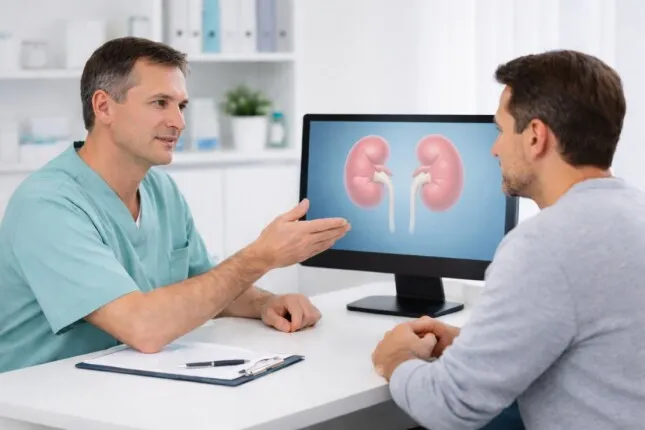
Patients often learn about a kidney stone in two completely different situations. In the first, a person comes for an ultrasound “just in case” or because of a dull pulling pain in the lower back, and the report suddenly includes the phrase: “renal calculus.” In the second, everything begins with acute pain, anxiety, an ambulance call, and only afterward it becomes clear that the cause was a stone. And this distinction is very important: the same diagnosis may mean either calm observation, or a situation in which delay begins to work against the kidney.
In clinical practice, a kidney stone is not always an emergency story. But it is also not the kind of finding that makes sense to simply “carry around” for years without understanding what it means specifically for you. My task as a urologist in such cases is not just to confirm the presence of a stone, but to understand how dangerous it is based on its location, behavior, effect on urine outflow and risk of complications.
I have seen many situations where patients reassured themselves too early because “nothing hurts.” And I have seen the opposite cases, where a single line in an ultrasound report frightened a person more than the actual clinical situation justified. That is why the right conversation about kidney stones begins not with panic and not with false reassurance, but with an attempt to understand the logic of the disease.
A Kidney Stone Is Not Always an Emergency, but It Is Not Always a Harmless Finding Either
For a patient, the word “stone” often sounds equally alarming in any situation. But for a urologist, what matters fundamentally is exactly where the stone is located, how it behaves, whether there are symptoms, whether it disrupts urine outflow, and whether there are signs of inflammation. One stone truly can be observed. Another, even without very dramatic symptoms, already requires an active approach.
Why One Stone Can Be Observed, While Another Cannot Be Ignored
Not every stone found in the kidney needs to be removed immediately. In practice, there are plenty of situations where the stone is small, relatively stable in position, causes no pain, does not impair urine outflow and shows no signs of inflammation. In such a case, we can talk about controlled observation – that is, not inaction, but a clear strategy with repeat evaluation over time.
But there are other scenarios as well. A stone may sit in a position where the risk of migration, ureteral blockage or gradual impairment of urine outflow is higher. It may coexist with infection, cause recurrent pain, enlarge, traumatize the mucosa or already affect kidney function. In that situation, the formula “do not touch it until it hurts more” is a poor decision.
What Patients Most Often Misunderstand
The most common misconception sounds like this: if the stone was found by accident, it means it is not dangerous. In reality, incidental detection means only that the problem was identified outside of an acute attack. It says nothing about the real risk posed by that stone over the coming months or years. The second typical misconception is judging everything only by size. The patient sees a number in millimeters and tries to decide independently whether it is “a lot” or “a little.” But the clinical significance of a stone is determined not by one number, but by context.
Another common mistake is to view the stone as a local mechanical problem: there is a stone, so it either has to be removed or you wait for it to pass. In reality, the stone is often only the visible part of a broader story – metabolic disturbances, urine composition, infection, urinary tract anatomy or a tendency to recur.
Why the Absence of Pain Still Does Not Mean Safety
The absence of pain is a pleasant but unreliable guide. Some stones truly remain asymptomatic for a long time. But that does not mean they are not growing, not shifting and not affecting the kidney. Moreover, in clinical practice, the most deceptive situations sometimes develop not against a background of severe pain, but during prolonged relative well-being, when a person gets used to the idea that “if it were dangerous, I would feel it.”
The kidney does not always signal dramatically. Sometimes the process moves slowly: the stone remains in place, maintains chronic inflammation, worsens urodynamics, and yet there is no pronounced attack. So calm symptoms are not yet the same as a calm disease.
Why Kidney Stones Develop and What Most Often Triggers Their Growth
If a patient asks me, “Why did I develop a stone specifically?”, the honest answer almost never fits into a single cause. Kidney stones are rarely the result of one factor alone. Usually, they form at the intersection of several conditions that gradually make the urine more “favorable” for salt crystallization and stone growth.
A Stone Is Not an Accident, but the Result of Several Factors
A kidney stone does not appear out of nowhere. Even if it is discovered unexpectedly, the process of formation has usually been going on for quite some time. First, conditions arise in the urine that favor crystallization – the concentration of salts becomes higher than it should be, acidity changes, and the balance of substances that normally prevent crystals from sticking together and growing is disrupted. Then microcrystals, sand and small calculi appear. And only after that does the stone form – the one the patient sees on ultrasound or CT.
That is why a stone is usually not a random episode, but the result of a certain internal logic of the body. In some people, dehydration and diet dominate. In others, the metabolic background. In others, infection or the anatomical features of the urinary tract. And until that logic is understood, the risk of recurrence remains.
What Most Often Increases the Risk in Real Practice
If we speak not in the language of textbooks, but in the language of real urology, I most often see the same set of factors. Chronically insufficient fluid intake is one of the most common. A person may not think of themselves as drinking too little, but in reality spend much of the day in a state of concentrated urine. The second typical factor is excess salt and animal protein with a modest drinking pattern. The third is urinary tract infections, especially if they recur or smolder over time.
To this we add hereditary predisposition, metabolic features, a sedentary lifestyle, episodes of impaired urine outflow, and sometimes coexisting gastrointestinal diseases and endocrine disorders. It is the combination of such factors that most often creates the environment in which a stone begins to grow.
Why Stones Often Come Back Again
Patients often view a stone as a one-time problem: it was found, removed, forgotten. But stones return precisely because the stone itself is a consequence, not the cause. If, after the stone is removed, the drinking pattern does not change, the diet is not corrected, metabolic disorders are not assessed, the stone composition is not taken into account, and infection is not treated, the kidney remains in the same conditions in which the stone had already formed once before.
That is why in urology it is very important not only to remove the stone, but also to understand why it appeared in this particular patient. Without that, treatment easily turns into a repeat of the same scenario a few months or years later.
What Symptoms Kidney Stones Cause – and Why They Can Stay Silent for a Long Time
One of the reasons patients underestimate kidney stones is their unpredictable behavior. One stone may remain almost unnoticed for a long time. Another begins to show itself through a dull pulling pain. A third leads straight to renal colic. And that is exactly why an article about kidney stones should speak not only about pain, but also about the silence in which the disease sometimes develops in its most deceptive form.
A Pulling Lower Back Pain That Is Often Mistaken for Something Other Than the Kidney
Many patients with kidney stones do not come in saying, “I have a urological problem.” They come with a story about their back: it pulls, aches, feels uncomfortable after exertion, worsens after a bumpy trip, interferes during an active day. And very often this is blamed on the spine, muscles, fatigue or sedentary work. In some cases, that explanation really does turn out to be correct. But sometimes, behind that “ordinary” pain, there is a kidney stone.
Larger stones located in the renal pelvis or calyces often behave this way. They may not cause an acute attack, but can create constant or intermittent discomfort. These are often the stones patients tolerate the longest.
When the Stone Starts Moving and Renal Colic Begins
The situation changes abruptly when the stone shifts and begins to impair urine outflow. Then renal colic develops – one of the most intense pain syndromes in urological practice. The pain often starts suddenly, makes it impossible to find a comfortable position, may radiate to the groin, and may be accompanied by nausea, vomiting and false urges to urinate. The person paces and shifts, but finds no relief.
It is important to understand that colic is no longer just a symptom of a stone, but a clinical signal that urine outflow is impaired. In such a situation, the question is not only how to relieve the pain, but also how safe the situation is for the kidney.
Read more about the symptoms and first aid during such an attack in the article Renal Colic.
Blood in the Urine, Nausea, Fever – Which Signals Must Not Be Missed
Kidney stones can present with more than pain alone. Patients are often frightened by blood in the urine – and rightly so, because this symptom must not be ignored. A stone can traumatize the mucosa, cause microscopic hematuria or more visible discoloration of the urine. Nausea and vomiting often occur against the background of pain. If fever, chills and pronounced weakness appear, this already raises concern about infection associated with the stone.
It is exactly the combination of a stone, pain, fever and signs of impaired urine outflow that I always regard as a more dangerous scenario than simply “lower back discomfort.” In such cases, the approach needs to be faster and more careful.
Can a Kidney Stone Cause No Pain at All?
Yes, it can. And this is one of the main reasons patients so often underestimate the problem. A stone may be found incidentally during an ultrasound performed for another reason, and the person genuinely does not understand why they should be concerned at all. But the absence of pain does not cancel the need for evaluation. It is necessary to understand where the stone is located, whether it affects urine outflow, whether it is growing, whether there is inflammation, and what the risk of complications is.
In urology, an asymptomatic stone is not necessarily a “good stone.” It is simply a stone without dramatic complaints at this moment. And the clinical significance of such a finding still has to be assessed separately.
What Really Matters to a Urologist: Size, Location, Urine Outflow or Symptoms?
If I had to reduce urological thinking to one sentence, it would sound like this: everything matters at once, but in the right hierarchy. The patient most often focuses on size. The urologist focuses on the clinical meaning of that size in a конкретный situation. The same stone under different conditions may mean a different level of risk and a different treatment strategy.
Why Risk Is Not Determined by Stone Size Alone
Size matters, but it should never be the only criterion. A small stone can be highly problematic if it is prone to migration and capable of blocking the ureter. A large stone may remain relatively “quiet” for some time, yet slowly damage the kidney. That is why the question “is a 4 or 6 mm stone dangerous?” does not have an honest answer by itself without knowing the location, symptoms, urine outflow and the overall clinical picture.
That is exactly why I try to help patients stop making decisions based only on the number in the ultrasound report. The number matters, but it does not replace clinical judgment.
How Location Changes the Clinical Picture
A stone in a calyx, a stone in the renal pelvis, and a stone that has started moving toward the ureter are already different stories. Location determines the symptoms, the likelihood of impaired urine outflow, the risk of an attack and the choice of further management. One stone may be a relatively incidental finding. Another, by being in a more vulnerable place, creates a completely different degree of threat for the kidney.
That is why evaluating location for a urologist is not a formality in the imaging report, but one of the key factors that explains to the patient why the strategy in their case is exactly this one and not another.
Why Even a Small Stone Can Cause a Serious Problem
Patients often reassure themselves by saying, “The stone is small, so it is nothing serious.” But a small stone may start moving and block the ureter. It may provoke colic, severe pain, obstruction of the kidney and the addition of infection. Sometimes it is precisely a small mobile stone that creates the most dramatic clinical picture.
That is why small size should not automatically be interpreted as permission to do nothing. It is important to understand the behavior of the stone and the context in which it exists.
When a Large Stone Can Remain Deceptively “Quiet” for a Long Time
Large stones, and especially staghorn stones, may go for months or even longer without causing a dramatic attack. A person gets used to intermittent discomfort, dull pulling pain and generally “vague” symptoms. And that calm becomes the trap. Because during that time, the stone may sustain inflammation, impair urodynamics and gradually worsen kidney function.
In my practice, there have been cases where a relatively calm course turned out to be more dangerous than a dramatic pain episode. Severe pain at least forces a person to seek medical care immediately. A quiet scenario, by contrast, often leads to prolonged delay in making a decision.
How a Urologist Decides Whether a Stone Can Be Observed or Should Be Treated
This is one of the most important questions for a patient. And this is exactly where oversimplifications become especially dangerous. A kidney stone does not divide into two primitive options: “either urgent surgery or do nothing.” Between these extremes lies a large zone of clinical decision-making, where the strategy depends on the combination of symptoms, dynamics, location, risk of complications and the overall condition of the kidney.
When Controlled Observation Is Acceptable
Observation is acceptable when the stone does not cause pronounced symptoms, does not impair urine outflow, is not accompanied by infection, does not show dangerous dynamics and does not appear to be a source of imminent complications. But the key word here is controlled. This does not mean forgetting about the stone until the next attack. It means having a clear plan for repeat evaluation and understanding which signs should change the management strategy.
Such an approach can be entirely reasonable, but only if it is based not on false reassurance, but on a proper urological assessment.
Which Signs Mean It Is No Longer Safe to Wait
If the stone causes recurrent pain, if fever appears, if blood in the urine increases, if lab results worsen, if urine outflow becomes impaired, if the stone enlarges or starts to change position, the situation is no longer comfortable for a watchful waiting approach. Episodes of colic, signs of infection and anything that raises doubt about preservation of kidney function are particularly concerning.
Put simply, you can wait only where waiting remains safe. As soon as signs of risk appear in the picture, the waiting itself becomes part of the problem.
Why a Decision Cannot Be Made Based on One Ultrasound Alone
Ultrasound is an important and often the first method of evaluation. But making a final decision about observation or treatment based on a single ultrasound finding can be risky. Ultrasound may show a stone, but it does not always fully answer the question of its actual behavior, exact location, degree of threat to urine outflow, and risk of complications.
That is why a competent strategy does not come down to phrases like “the ultrasound says 5 mm, so it is nothing serious” or “8 mm, so it has to be removed urgently.” A physician must always evaluate the finding in its clinical context.
What Usually Goes Into the Clinical Assessment Before Choosing a Strategy
Before making a decision, the urologist evaluates the complaints, duration of symptoms, episodes of colic, the presence of blood in the urine, fever, possible infection, laboratory findings, imaging, the impact of the stone on urine outflow, the trend compared with previous studies, and the overall condition of the kidney. Put more simply, we assess not only the stone itself, but the entire situation around it.
And this is exactly what distinguishes a medical decision from everyday reasoning based only on size and advice from the internet.
When Kidney Stones Truly Become Dangerous
Patients often ask: “When does this become dangerous?” And it is the right question. Not because a person should live in constant anxiety, but because a kidney stone can remain for a long time on the borderline between acceptable observation and increasing risk. It is important to recognize the moment when that line has been crossed.
Impaired Urine Outflow and Risk to the Kidney
The most important risk a urologist has no right to underestimate is impaired urine outflow. When a stone creates a blockage or significant obstruction, pressure in the upper urinary tract rises. For the kidney, this means strain, worsened microcirculation, a risk of swelling, and tissue damage. For the patient, it means pain, attacks, sometimes reduced urine volume, and worsening general condition.
The longer such a situation persists, the worse the prognosis for kidney function. That is why the issue of urodynamics so often becomes decisive in choosing the treatment strategy.
Infection in the Presence of a Stone – a Scenario That Must Not Be Underestimated
A stone by itself is unpleasant. A stone plus infection is already much more dangerous. If fever, chills, weakness, and a pronounced worsening of general condition appear in the presence of a calculus, this is no longer just about pain, but about a complicated course. The combination of infection with impaired urine outflow is especially dangerous – in such situations, the risk of a severe inflammatory process rises sharply.
That is why I always ask patients not to endure it and not to treat themselves blindly at home if fever joins the pain. In urology, this is one of those symptoms that requires a different level of attention.
Why “Tolerable” Pain Can Sometimes Be More Dangerous Than a Dramatic Attack
A dramatic attack frightens and mobilizes. The patient calls an ambulance, gets evaluated, and seeks help. But tolerable yet recurring pain often turns into a background condition a person gets used to. And it is exactly in this scenario that a decision can be postponed the longest while the stone keeps doing its damage.
So the absence of dramatic pain still does not mean low risk. Sometimes the more dangerous scenario is the prolonged, non-dramatic, and therefore underestimated process.
In Which Situations Urgent Medical Care Is Needed
If, in the presence of a stone, severe pain develops that cannot be tolerated, if fever, chills, repeated vomiting, pronounced blood in the urine, a noticeable decrease in urine output, or rapid deterioration appear, this is no longer a situation for a waiting strategy. It requires urgent medical care and physician evaluation.
The meaning of such a response is simple: it is important not to miss the moment when the stone stops being just a finding and becomes a source of real danger to the kidney and the patient’s overall condition.
Which Examinations Help Determine How Safe the Situation Is
Good diagnostics in kidney stones are needed not for the quantity of tests, but for the quality of the decision. The goal is not to “order everything,” but to answer several key questions: where the stone is located, whether it affects urine outflow, whether there is inflammation, whether kidney function is suffering, whether the situation can be observed safely, and what the risk of complications is.
Ultrasound – What It Shows and What It Does Not
Ultrasound is often the first method with which a patient’s story begins. And that is understandable: it is accessible, noninvasive, and helps reveal a calculus, assess the kidney, the collecting system, and possible indirect signs of impaired urine outflow. In many situations, this is enough for the first clinical step.
But it is also important to understand the limitations of ultrasound. It does not always provide an exhaustive answer about the exact location of the stone, its behavior, its true size, and the degree of threat it represents. That is why a good urologist uses ultrasound as part of the assessment, not as the only source for a decision.
When CT or More Precise Imaging Is Needed
If the clinical situation is unclear, if obstruction is suspected, if there is a need to understand the size, location, and characteristics of the stone more precisely, or if the pain is pronounced or recurrent, computed tomography or other more precise imaging may be required. This is not “making life harder for the patient,” but a way to make the right decision when one ultrasound image is not enough.
This is especially important in situations where the choice between safe observation and active treatment depends on the accuracy of the assessment.
Urine and Blood Tests – Why They Matter in Practice
Patients sometimes perceive tests as a routine formality. But it is exactly these tests that help reveal whether there is inflammation, blood in the urine, signs of infection, indirect changes in kidney function, and urine characteristics that may point to a metabolic background and a risk of complications. In some cases, laboratory data change the clinical assessment more strongly than the stone size itself.
So tests are not ordered “for the file,” but to answer one question: how safe is what is happening right now.
Why It Is Sometimes Important to Observe a Stone Over Time
A single finding gives only a snapshot of the situation. But what becomes clinically significant is often how that situation changes over time. Is the stone growing, is it changing position, are new symptoms appearing, is the condition of the kidney changing, do the tests remain stable – all of this can sometimes matter more than the initial report. That is why dynamic observation of certain stones is not passivity, but a deliberate medical strategy.
What to Do If a Kidney Stone Is Found Incidentally and Nothing Hurts
This is one of the most common and most underestimated scenarios. A person comes for an ultrasound for another reason, receives a report mentioning a stone, and ends up caught between two extremes: either becoming too frightened, or deciding that if nothing hurts, nothing needs to be done. Both reactions can be wrong.
When Calm Observation Is Possible
Calm observation is possible when the stone causes no symptoms, does not impair urine outflow, is not accompanied by infection, is not growing dangerously, and does not appear to be the source of imminent complications. In such a situation, the urologist may recommend follow-up, repeat imaging, evaluation of test results, and preventive measures without immediate active intervention.
But the key point here is that this calm must be justified. Not by everyday logic, but by clinical reasoning.
When Even an Asymptomatic Stone Requires Active Management
Even without pain, a stone may still be clinically unsafe. This may happen if it is large, unfavorably located, growing, affecting urodynamics, associated with infection, already altering the condition of the kidney, or appears to be the source of a high probability of future problems. In such cases, the absence of symptoms does not cancel the need to discuss treatment.
That is why a decision about management of an asymptomatic stone should always be made only after a full evaluation, not according to the principle of “if it does not hurt, do not touch it.”
Why “It Does Not Hurt” Does Not Always Mean “It Is Not Dangerous”
The absence of pain means only that there is no dramatic pain signal at this moment. But it does not answer questions about stone growth, the risk of migration, the threat to urine outflow, chronic inflammation, or future complications. So an asymptomatic stone is not a reason to panic, but neither is it permission to forget the problem completely.
Can the Growth of New Stones and Recurrence Be Prevented?
If a patient asks me whether it is possible to make sure stones never come back, I answer honestly: there is no one hundred percent guarantee. But the risk of recurrence can be reduced very substantially if we do not stop at removing the stone that already exists and instead build prevention correctly. In urology, this is one of the most underestimated, but also one of the most rewarding stages of care.
Why Removing a Stone Does Not Mean the Disease Is Over
Removing a calculus solves the current mechanical problem, but it does not always change the environment in which that stone formed. If, after treatment, a person returns to the same hydration habits, the same diet, ignores infections, and does not complete follow-up, the same story can easily repeat itself.
That is why after stone removal, the question should not only be “was everything removed?”, but also “what have we done to make sure it does not grow again?”.
Hydration – The Most Underestimated Part of Prevention
Of all preventive measures, adequate fluid intake is the one patients underestimate most often, because the advice seems too simple. But clinically, it is one of the most important. The more concentrated the urine, the easier it is for salts to crystallize and create conditions for new stones to grow.
Hydration does not mean one mechanical standard “the same for everyone.” But the principle remains universal: you cannot live in a constant state of chronically concentrated urine and at the same time expect that recurrence will not happen.
Why There Is No Single “Stone Diet”
Patients often like to search for a list of foods that can be declared the single culprit. But there is no universal stone diet. Yes, excess salt, a heavy tilt toward animal protein, hydration mistakes, and certain dietary patterns do play a role. But proper dietary prevention must take into account the stone composition, metabolic background, laboratory findings, and the clinical situation.
That is why I always try to move the patient away from the idea of “finding one lifelong ban” and toward a more mature understanding: nutrition matters, but it should be discussed not as a mythical list of taboos, but as part of individualized prevention.
When Stone Analysis and Individualized Prevention Are Needed
If the stone passed spontaneously or was removed, it is important, whenever possible, to analyze its composition. This gives the physician real information about the mechanism of stone formation. The same diagnosis – kidney stones – may include calculi of very different nature. That means prevention without knowing the composition often remains too general.
This is especially important in recurrent cases, with large stones, bilateral disease, combination with infection, and a complex metabolic background. In such situations, general advice is no longer enough.
What Really Matters for the Patient
If we translate prevention into simple and useful language, it begins with very basic things: do not allow chronic dehydration, do not ignore recurring pain, do not disappear from follow-up immediately after the stone passes or is removed, and do not calm down just because the acute episode is over. With kidney stones, recurrence is usually easier to prevent than to go through pain, urgent diagnostics, and treatment all over again.
Frequently Asked Questions About Kidney Stones
Can a Kidney Stone Cause No Pain for Years?
Yes, it can. Some stones truly remain without dramatic symptoms for a long time. But that is exactly why they should not automatically be considered safe. The absence of pain does not answer questions about stone growth, the risk of migration, inflammation, or the effect on kidney function. That is why even an asymptomatic stone requires at least an initial urological evaluation and a clear management strategy.
Does a Kidney Stone Need to Be Removed If It Was Found Incidentally?
Not always. An incidentally discovered stone is not an automatic indication for removal. But it is not something to dismiss either. Its size, location, effect on urine outflow, dynamics, risk of complications, and clinical context all need to be understood. Only then can we say whether observation is reasonable or whether it is already time to discuss active treatment.
What Size of Kidney Stone Is Considered Dangerous?
Danger is not determined by size alone. It is an inconvenient but honest answer. A small stone may be clinically problematic if it tends to migrate and block the ureter. A larger stone may behave relatively quietly for a long time, but gradually damage the kidney. So size matters, but without location, symptoms, urodynamics, and the overall clinical picture, it does not decide anything by itself.
Can a Small Stone Be More Dangerous Than a Large One?
Yes, it can. Especially if it starts moving and disrupts urine outflow. Small mobile stones are often the cause of dramatic renal colic and an acute pain scenario. Meanwhile, a larger stone in the kidney may behave more quietly for some time. That is why in urology there is no simple formula of “larger means more dangerous.”
Can a Kidney Stone Be Dissolved Without Surgery?
That depends on the stone composition and the clinical situation. Not all calculi are susceptible to medical dissolution at all. More than that, attempts to treat “blindly,” without understanding what kind of stone it is and how it behaves, are rarely reasonable. That is why the possibility of conservative management should always be discussed only after a proper evaluation, not according to the principle of “I will try drinking something at home.”
What Should You Do If a Kidney Stone Is Seen on Ultrasound for the First Time?
Do not panic, but do not ignore it either. The first step is to understand the clinical meaning of the finding. Complaints, laboratory tests, the possible impact on urine outflow, and, if needed, more precise imaging should all be assessed, and the situation should be discussed with a urologist to determine whether the stone can be observed safely or whether there are reasons to consider a more active strategy.
Does a Kidney Stone Always Lead to Renal Colic?
No. Some stones do not cause colic at all for a long time. Colic usually occurs when the stone begins to move and disrupts urine outflow. So the absence of colic does not cancel the presence of a problem. And conversely, colic itself no longer speaks only to the fact that a stone exists, but that the situation has become acute and requires a faster decision.
What the Patient Should Know
Kidney stones are not always an urgent urological emergency, but they are almost always a condition that should not be judged superficially. The main mistake is to make a decision based on only one sign: only on pain, only on size, only on the ultrasound report, or only on the fact that “nothing seems to be bothering me right now.” Medical logic here is always broader.
For a urologist, what matters is understanding what kind of stone this is in clinical terms: a quiet finding under observation, or a source of increasing risk. That is what determines whether follow-up alone is enough, whether diagnostics need to be expanded, whether waiting is justified, or whether it is already time to move to a more active strategy.
If we put it very briefly, the main conclusion is this: what is dangerous is not the mere presence of the word “stone” in the report, but underestimating what it means. And conversely, a calm, timely, and competent decision is usually more useful and safer than either panic or prolonged neglect of the problem.


Clinical Guidelines and References
- EAU Guidelines on Urolithiasis. European Association of Urology – latest edition.
- Türk C. et al. EAU Guidelines on Diagnosis and Conservative Management of Urolithiasis. European Urology.
- Skolarikos A. et al. Metabolic Evaluation and Recurrence Prevention for Urinary Stone Disease. European Urology.
- Preminger G.M. et al. Guideline for the Management of Ureteral Calculi. Journal of Urology.
- Miller O.F., Kane C.J. Time to Stone Passage for Observed Ureteral Calculi. Journal of Urology.
- UpToDate. Nephrolithiasis in Adults: Pathogenesis, Clinical Features, and Diagnosis.
- National Institute for Health and Care Excellence (NICE). Renal and Ureteric Stones – Assessment and Management.