



Sometimes, even during adolescence, a girl notices that her breasts are growing primarily forward, remaining narrow at the base and developing an elongated, almost triangular shape rather than rounded contours. In some women, these features are barely noticeable, while in others, the breasts resemble cones or small tubes, and the right and left breasts may look different.
Often, this shape remains unchanged over the years, even as breast volume increases. A woman may regard it as an individual characteristic of her body, but she may also have difficulty finding a well-fitting bra or wonder why her breasts developed this way. Frequently, it is not until adulthood that she first encounters the medical term “tubular breasts” and begins to relate it to her own observations.
How to Recognize Tubular Breasts and Distinguish Them From Other Breast Changes
Tubular, or tuberous, breasts are a developmental variation in which the breast base and certain areas of glandular tissue form differently than they do with more uniform breast growth. In plastic surgery, this anatomy is described as a tubular breast deformity. The term refers to the structure of the breast, not its health, and certainly does not mean that a woman necessarily needs treatment.
The appearance of tubular breasts can vary considerably. Sometimes the characteristic features are immediately apparent, while in other cases they are so subtle that distinguishing them from an individual variation in breast shape requires an examination. What matters is not simply whether the breasts are rounded or elongated, but how the breast base, lower portion, and tissue distribution have developed.
Why Cone-Shaped Breasts May Develop
Tubular breast shape is associated with variations in the anatomical development of the mammary gland, although its exact cause has not yet been established. The most widely discussed hypothesis concerns the structure of the connective tissue surrounding and supporting the glandular structures. It is thought that, in certain areas, this tissue may create increased resistance to growth, preventing the breast from expanding evenly outward and downward.
As a result, the breast base remains relatively narrow, the lower portions may be underdeveloped, and the growing glandular tissue tends to project forward. Sometimes, part of this tissue protrudes through the areolar region, giving it additional prominence. This combination of anatomical features can produce a conical or tubular breast shape.
This model provides a reasonable explanation for the characteristic appearance, but it cannot be considered a definitively proven mechanism for every case of tubular breast deformity. No single genetic, hormonal, or external cause has been identified that inevitably leads to this breast shape. Similar features are sometimes seen among close female relatives, but family resemblance alone does not establish a specific pattern of inheritance.
These anatomical characteristics usually become noticeable during puberty, when the breasts begin to grow more actively. This does not mean that previously healthy breasts suddenly become deformed at a particular age. Rather, an underlying developmental variation becomes apparent as the tissues grow. There is no evidence that wearing an ill-fitting bra, exercising, sleeping in a particular position, or having an insufficiently caloric diet during childhood causes tubular breasts.
Main Signs of Tubular Breast Shape
The most characteristic feature of tubular breasts is a constricted breast base, meaning a relatively small area where the breast attaches to the chest wall. With more uniform development, the breast expands not only forward but also sideways, while its lower portion gains volume and develops a smooth contour. In tubular breasts, these proportions may be altered: the breast appears narrow and elongated, with insufficient fullness in the lower pole.
In some women, the inframammary fold, or crease beneath the breast, sits higher than expected, leaving a relatively short distance between the areola and the fold. The areola may also be enlarged or project noticeably forward because of the underlying glandular tissue. However, these features are not present in every case and may have other causes.
Tubular breast deformity may affect both breasts or predominantly one breast. The degree of change also often differs between the right and left sides. Breast size is not a reliable indicator: tubular characteristics can occur in women with either small or relatively large breasts.
It is important to understand that triangular or cone-shaped breasts do not necessarily indicate a tubular breast deformity. Some women naturally have more pointed breast contours, while the breast base, lower pole, and tissue distribution have developed without the characteristic restrictions. A protruding areola is not, by itself, a required sign of tubular breasts. What matters is not only the external shape but also the width of the breast base, development of the lower pole, position of the inframammary fold, and distribution of glandular tissue. It is the combination of these findings that helps distinguish a tubular deformity from individual variations in breast shape.
Tubular breasts should also be distinguished from breast ptosis, or sagging. With ptosis, the position of the breast changes relative to the inframammary fold, usually because of aging, weight fluctuations, pregnancy, or other factors. In tubular breast deformity, the defining feature is the underlying structure of the breast itself. These conditions can coexist, but neither is a form of the other.
What Are the Different Types of Tubular Breast Deformity?
Tubular breast deformity does not have the same degree of severity in every woman. Plastic surgeons use several classification systems to describe which regions of the breast are underdeveloped and how severely its base is constricted. One well-known system is the Grolleau classification, which identifies three types of tubular breasts.
- Type I. Underdevelopment primarily affects the lower inner portion of the breast, closer to the center of the chest. The remaining areas may have relatively normal volume, so the changes can sometimes appear mild.
- Type II. Underdevelopment affects both lower portions of the breast. The breast base appears more constricted, the lower pole is shortened, and the breast more often develops a noticeably elongated shape.
- Type III. Restricted development extends throughout nearly the entire breast. The base is significantly constricted, and the breast may have a pronounced tubular shape with tissue protruding through the areolar region.
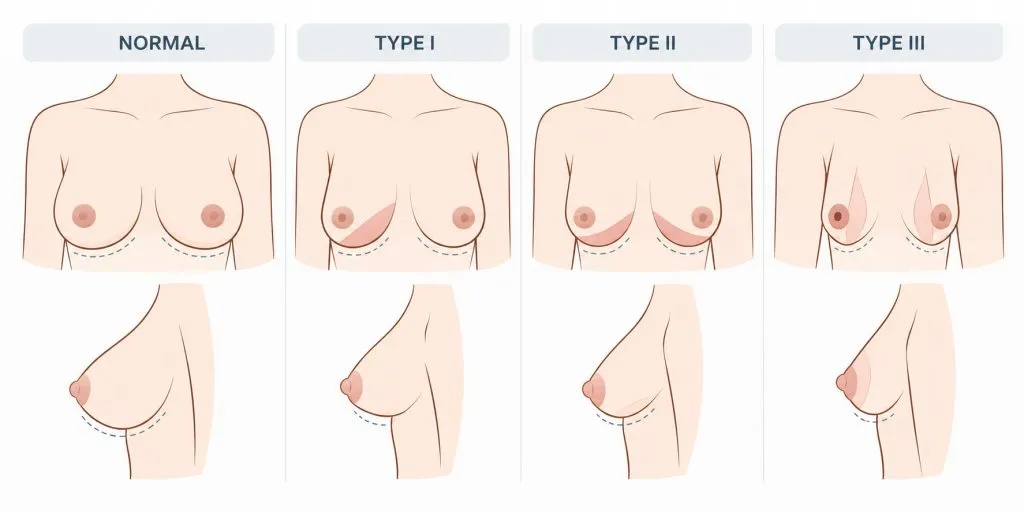
This classification primarily describes the location and extent of anatomical changes, not how dangerous the condition is. Other systems, including four-type classifications, are also used in clinical practice. For this reason, trying to determine your own “type” from photographs and treating it as a definitive diagnosis is not advisable.
Can Tubular Breasts Be Corrected?
The possibility of changing breast shape depends primarily on the anatomical characteristics responsible for it. When a tubular breast deformity has fully developed, the goal is not simply to increase breast volume. The width of the breast base, development of the lower portions, position of the inframammary fold, and distribution of tissue all need to be considered. These characteristics explain why some approaches produce only a temporary visual change, while others can alter breast contours more substantially.
Can Triangular Breasts Become Rounder on Their Own?
During puberty, breast shape is not yet fully established. Breast development occurs gradually, and the rate of growth, increase in volume, and changes in contour can vary considerably from one girl to another. Therefore, cone-shaped breasts at ages 13–15 do not necessarily retain that appearance in adulthood. Appearance alone during the early stages of development is not enough to confidently conclude that a girl has a persistent tubular breast deformity.
However, if the breast base is genuinely constricted and the lower portions are underdeveloped, spontaneous correction of these characteristics should not be expected. The breasts may grow and become fuller, but the characteristic tissue distribution often remains. Sometimes tubular features become less noticeable with age, while in other cases increasing breast volume makes differences between individual regions more apparent.
Once puberty is complete, substantial spontaneous changes in an established tubular breast shape are unlikely. Even so, there is no strict age cutoff that applies to every woman. Breast development does not end at exactly 16 or 18 years of age for everyone, so when evaluating a young patient, a physician considers not only her chronological age but also whether her breasts are still developing.
Pregnancy and breastfeeding, as well as significant changes in body weight, can affect breast volume and skin condition. Sometimes the breasts appear rounder afterward, while in other cases the lower portion remains insufficiently full or signs of sagging develop. It is impossible to predict exactly how tubular breasts will change. An increase in breast size does not necessarily mean that the underlying constriction of the breast base has resolved.
Can Cone-Shaped Breasts Be Changed Without Surgery?
When cone-shaped contours are caused by tubular breast anatomy, there is currently no proven nonsurgical method that can permanently widen the constricted breast base and restore the missing volume of the lower pole. This applies not only to home remedies but also to various cosmetic procedures sometimes promoted as alternatives to plastic surgery.
Chest muscle exercises can improve muscle strength, posture, and, to some extent, the appearance of the chest. However, the breast itself consists primarily of glandular, fatty, and connective tissue rather than muscle. Exercise therefore cannot change the arrangement of glandular structures or correct restricted development in specific areas of the breast.
Massage, creams, oils, and device-based cosmetic treatments also cannot create an underdeveloped lower breast pole or widen the breast base. Some products may temporarily improve skin condition, but that is an entirely different goal. Wearing a properly fitted bra can support the breasts and change their silhouette under clothing, but it does not alter their underlying anatomical shape.
Hormonal medications deserve particular attention. Because breast development is influenced by sex hormones, some women assume that taking estrogen or other hormonal medications might make their breasts rounder. However, tubular breast deformity is not, by itself, a sign of estrogen deficiency, and hormone therapy is not considered a treatment for this condition. Such medications should not be prescribed solely to change breast shape in the absence of a diagnosed endocrine disorder.
Changes in body weight also do not produce predictable results. Gaining weight may increase the amount of fatty tissue in the breasts, but fat distribution varies from person to person, and the characteristic constriction of the breast base may remain. Deliberately gaining weight to correct tubular breast shape has no medical justification.
How Is Tubular Breast Shape Corrected Surgically?
Surgical correction of tubular breasts focuses less on increasing breast size and more on changing breast proportions by widening the constricted base, restoring insufficient volume in the lower portions, and creating smoother contours. Depending on the severity of the deformity and the amount of existing breast tissue, different techniques may be used, sometimes in combination.
With mild to moderate tubular characteristics and sufficient breast volume, correction using the patient’s own tissue may be possible without implants. The surgeon redistributes glandular tissue to improve the shape of the lower pole and create more natural breast contours. This approach can preserve the original breast size or change it only slightly.
If there is insufficient tissue or a woman also wants larger breasts, correction may be combined with breast implants. However, standard breast augmentation does not always correct a tubular deformity. When the breast base is significantly constricted, the distribution of glandular tissue must also be addressed. Therefore, the choice of implant and surgical technique depends not only on the desired size but also on the original breast anatomy.
Another possible method is fat grafting, also known as lipofilling, which involves transferring the patient’s own fat tissue. It is primarily used to restore volume in specific areas, improve contours, and smooth out localized irregularities. In some cases, fat grafting may be used on its own, but with pronounced tubular deformity, it is generally insufficient to achieve a comprehensive change in breast shape.
If tubular breasts are accompanied by sagging or significant excess skin, a breast lift may also be necessary. Areolar correction is performed only when appropriate indications are present and the patient wants it, rather than being a mandatory part of every procedure.
Surgical correction of tubular breasts is therefore not a single standardized procedure. When changes are mild, reshaping the patient’s own tissue may be sufficient, while other cases require a combination of techniques. When choosing an approach, it is important to consider not only the desired shape but also possible scars, limitations of the result, and surgical risks. Complete symmetry and correction of every anatomical characteristic cannot be guaranteed.
Do Tubular Breasts Need to Be Corrected if They Cause No Physical Problems?
Tubular breast anatomy is not, in itself, a disease that requires treatment simply because the breasts have a different shape. A woman may have pronounced tubular characteristics but be entirely satisfied with her appearance, experience no physical discomfort, and see no reason to seek surgical treatment. From a medical standpoint, this is a perfectly acceptable situation.
Tubular breast shape also does not necessarily mean that the mammary gland functions abnormally. In some women, differences in glandular tissue development may be associated with insufficient glandular volume and may affect milk production after childbirth. However, appearance alone cannot determine whether breastfeeding will be successful. Many women with tubular breasts breastfeed their children, and lactation difficulties also occur in women without these anatomical characteristics.
At the same time, not every breast symptom should automatically be attributed to tubular anatomy. Pain, lumps, nipple discharge, skin changes, or a rapidly developing change in the shape of one breast require a separate medical evaluation. It is especially important not to mistake a noticeable change in breast shape that develops during adulthood without an obvious cause for a congenital variation. In such cases, the priority is diagnosis rather than aesthetic correction.
If a woman is considering surgery, the decision is usually based on her own desire to change the shape of her breasts. This may be related to a pronounced difference between the breasts, difficulty finding suitable bras, the way she perceives her body, or simply a preference for different proportions. None of these reasons requires justification, but the availability of surgical correction should not be interpreted as an obligation to undergo it.
Decisions about surgery require particular caution during adolescence, when breast development may still be ongoing. In addition to the degree of breast maturity, it is important to consider the maturity of the patient’s expectations, how consistent her desire for a change in appearance has been, and the possible consequences of surgery. For adult women, it is equally important to determine in advance exactly what they want to change and how achievable that result is given their anatomy.
Tubular breasts can remain an individual physical characteristic throughout a woman’s life without requiring medical intervention. If their shape genuinely bothers her, modern plastic surgery offers correction techniques, but the choice of treatment should be based on her actual anatomy and her own informed decision.


Clinical Guidelines and References
- Grolleau J. L., Lanfrey E., Lavigne B., Chavoin J. P., Costagliola M. Breast Base Anomalies: Treatment Strategy for Tuberous Breasts, Minor Deformities, and Asymmetry. Plastic and Reconstructive Surgery, 1999. The original publication introducing Grolleau’s three-type classification, based on developmental differences affecting specific regions of the breast.
- von Heimburg D., Exner K., Kruft S., Lemperle G. The Tuberous Breast Deformity: Classification and Treatment. British Journal of Plastic Surgery, 1996. A study of anatomical variations in tubular breast deformity and the four-type classification that preceded the Grolleau system.
- Review of Tuberous Breast Deformity: Developments over the Last 20 Years. Plastic and Reconstructive Surgery – Global Open, 2022. A scientific review of proposed causes, characteristic features, classification systems, and contemporary approaches to tubular breast correction.
- Tuberous Breast Management: A Review of Literature and Novel Technique Refinements. Plastic and Reconstructive Surgery – Global Open, 2022. A review of tubular breast anatomy, differences among the Grolleau types, and available surgical treatment options.
- van Durme J., Cooreman A., Paternoster J., Vranckx J. J. The Different Surgical Strategies for Treating Tuberous Breast Deformity: A Scoping Review. JPRAS Open, 2024. A scoping review of research on surgical correction techniques for tubular breasts, including tissue redistribution, breast implants, and fat grafting.