



This material is for informational purposes only and does not replace an in-person consultation.
Very painful periods almost never frighten a woman because of the pain alone. More often, what is frightening is something else: it is unclear whether this is “common for many women” or not, whether it can simply be waited out, what to take, why the pain is stronger than usual this time, and whether something more serious may be behind it.
In clinical practice, this uncertainty is exactly the most common point of entry. A woman does not always come in with the request, “Please give me a diagnosis.” Much more often, the question sounds simpler and more honest: “Why does it hurt this much right now, and what should I do today?”
And that is the right question. Because painful periods can indeed be part of a typical cycle, but only up to a certain point. When the pain starts disrupting normal life, requires more and more pain relief, changes sharply compared with previous cycles, or is accompanied by unusual symptoms, a doctor no longer sees it as a “feature of the body,” but as a clinical issue that needs to be worked through.
When Painful Periods May Be a Typical Episode and When They Are No Longer Normal
Moderate pulling or cramping pain in the lower abdomen on the first day of menstruation does not always mean there is a disease. In some women, this truly fits a typical pattern: the pain begins in the first hours of menstruation, lasts for a limited period, does not intensify from cycle to cycle, is not accompanied by marked weakness, near-fainting, fever, or unusual discharge, and overall remains controlled with a familiar, stable approach.
But there is a very important threshold after which a doctor stops seeing the situation as “just painful periods.” That threshold is defined not only by the pain scale, but by how exactly the pain behaves in a woman’s daily life.
If on the first day of menstruation a woman has to cancel plans, stay in bed, miss work, if the pain causes nausea, marked weakness, chills, trembling, dizziness, if the usual pain relief works less effectively than before, or if the nature of the pain itself has changed – this is no longer a situation that should automatically be filed under “my usual cycle pattern.”
In such cases, the doctor assesses not only intensity, but also dynamics. Very painful periods become especially important when they have become more painful than before, when the pain has for the first time become “unbearable,” when it appears after a period of relative stability, or when other new symptoms are added. It is precisely the change in the familiar pattern that is most often clinically more significant than the mere fact of pain itself.
What to Do Right Now if Your Period Is Very Painful
When the pain is severe, the first thing that usually makes the condition worse – is chaotic action driven by anxiety. A woman may endure it until the last moment, then take random medications, then start looking for dozens of pieces of advice that contradict one another. In practice, it is much more useful to act calmly and follow a clear logic: first reduce the spasm and the stress on the body, then assess whether the situation still fits a familiar pattern or has already gone beyond it.
What You Can Do in the First Hours
If the pain feels like pronounced cramping in the lower abdomen during the first hours of menstruation, and the overall condition remains stable, it is helpful to reduce physical activity, lie down or sit in a comfortable position, and ensure warmth and rest. A warm shower or moderate local heat applied to the lower abdomen truly reduces spasm in many women and makes the pain less intense.
At this point, it is very important not to continue normal activity “through the pain,” especially if the pain is already accompanied by abdominal muscle tension, weakness, or trembling. Sometimes, it is exactly the attempt to “push through it on your feet” that makes the first hours of the cycle noticeably harder.
If nausea is present, it is helpful to drink water or a warm beverage in small amounts rather than staying completely without fluids. Sudden weakness during pain is often intensified not only by spasm, but also by the body’s overall autonomic response.
When It Is Reasonable to Use Pain Relief and When It Is Better Not to Wait
If this is a familiar pattern of a painful first day of menstruation, and the pain truly resembles spasmodic menstrual pain without additional warning symptoms, it is reasonable to use the usual pain relief that has previously been effective and well tolerated. The key point here is simple: if the medication usually helps and the situation behaves the same way as in previous cycles, that is one clinical scenario.
But if the pain is noticeably stronger than usual, if pain relief does not provide the expected effect, if it has to be repeated more often than before, or if there is a feeling that “something is wrong, these are not my usual periods,” – then this is no longer a situation where it is best to simply wait. These are exactly the episodes a doctor considers a reason for separate evaluation.
If the pain is accompanied by marked weakness, dizziness, a near-fainting feeling, cold sweats, very heavy bleeding, fever, an unusual odor of discharge, or sharp one-sided pain, there should be only one priority: do not keep trying to explain everything away as “normal periods,” and do not delay seeking medical attention.
Which Actions Often Only Make the Situation Worse
One of the most common mistakes is taking severe pain as proof that “this happens, I just have to get through it.” In practice, this leads to delayed medical attention דווקא in the cases where the pattern has already changed a long time ago.
The second mistake is taking several painkillers one after another “just in case,” without understanding what has already been taken, at what dose, and at what interval. This does not make the response more appropriate – it only increases the risk of side effects.
The third mistake is explaining any atypical episode only by stress, a cold, a delayed period, or a “hormonal imbalance” if the pain has become significantly stronger than before. Sometimes a woman gets used for months to the idea that this is just a temporary disruption, while for a doctor this kind of pattern already looks like a reason to investigate the cause more deeply.
Why Periods Can Be Very Painful
Severe pain during menstruation is not one mechanism and not one diagnosis. That is exactly why trying to find one universal answer online is almost always disappointing. Two women may describe the complaint in the same way – “it hurts terribly on the first day” – but the clinical logic behind it may be very different.
For a doctor, what matters here is not only the presence of pain, but its origin: is this a pronounced but typical spasm; is it pain that has become too intense against the background of an already existing process; or is it pain that reflects another gynecological cause requiring separate evaluation.
When It Looks More Like a Pronounced Spasm Than a Separate Disease
In some women, painful periods are primarily related to a pronounced uterine response to the onset of menstruation. The contractions become more intense, sensitivity to those contractions is higher, and the first day of the cycle is harder to get through. That is why the pain is often strongest in the first hours or on the first day, and then gradually decreases.
This pattern is usually more predictable: it repeats in roughly the same way, without a sharp increase from cycle to cycle, without new symptoms, and without the feeling that “this time everything is different.” It may be unpleasant and even severe, but it remains relatively stable in its internal logic.
However, even in this case there is an important caveat: if the pain is so severe that a woman is regularly knocked out of normal life, and has to plan a “shutdown day” in advance with every cycle, this is no longer something that should automatically be considered a harmless personal pattern. For a doctor, even a mechanism-typical spasm may require a change in management if it has too great an impact on quality of life.
When Severe Pain May Reflect Other Gynecological Causes
If periods have become significantly more painful than before, if the pain lasts longer than usual, if it is accompanied by pelvic heaviness, soreness before menstruation begins, pain during intercourse, or pain that becomes stronger not only on the first day but later as well, the doctor is already thinking more broadly than simply “a strong spasm.”
In such cases, different causes may be considered: endometriosis, inflammatory changes, uterine fibroids, adenomyosis, consequences of previous procedures, specific aspects of recovery after an abortion, or other conditions in which menstruation itself becomes only the moment when the underlying problem becomes especially pronounced.
Here it is fundamentally important not to try to diagnose yourself based on a single symptom. The purpose of the article is not for a woman to decide on her own exactly what she has, but to understand in time that pain which is too severe or has changed is no longer the kind of situation that can be explained away by saying, “my periods are just like that.”
Why the Pain Is Often Strongest on the First Day
The query “painful periods on the first day” is very common, and it does indeed have a clear clinical basis. In the first hours of menstruation, the uterus responds more actively to the onset of the cycle, contractions are more pronounced, and the body has not yet adapted to this phase. That is why, for many women, the peak of pain occurs right at the start of menstruation.
But what matters is not only the fact that there is pain on the first day, but its scale. If this is a severe but familiar and time-limited episode that then begins to subside, that is one clinical story. But if the first day turns into a state where it is impossible to get up, with marked nausea, vomiting, trembling, profound weakness, and pain that “breaks” the usual cycle pattern and behaves differently, a doctor sees this as a much more significant signal.
If Your Periods Have Become More Painful Than Before
In practice, this scenario is often more important than simply saying, “I have always had painful periods.” When a woman says, “Yes, I had pain before, but this time it is completely different,” this is already a different category of complaint for a doctor. Because here we are evaluating not only the intensity of pain, but a change in the usual cycle pattern.
In clinical reasoning, a sharp increase in pain is not a detail – it is a key clue. Even if periods used to be unpleasant but tolerable, and now they have become very severe, this is a reason to evaluate the situation separately rather than treat it as a continuation of the old pattern.
When There Was a Delay and Then Painful Periods Started
The scenario “there was a delay, and then painful periods started” is common and almost always causes anxiety. Sometimes, after a delayed period, menstruation really is harder to get through: the volume of bleeding changes, cramping becomes more intense, and the first day feels more abrupt. Such an episode in itself does not always mean there is a dangerous problem.
But there is an important condition here: if the pain is truly limited to menstruation itself, if there is no progressively worsening condition, no very unusual symptoms, excessively heavy bleeding, fever, marked weakness, or atypical one-sided pain, the situation may still fit the pattern of a heavier, but still menstrual, episode.
But if after a delay the pain clearly feels atypical, sharply stronger than before, is accompanied by a marked decline in overall well-being, or by an unusual pattern of bleeding, the doctor no longer limits the explanation to “the cycle got disrupted.” At that point, it is more important to rule out other causes than to reassure yourself with a familiar phrase.
Why a Sudden Increase in Pain Is a Separate Reason for Evaluation
The body can produce unpleasant but understandable cyclic reactions. But when the pain changes abruptly, that matters especially. Not gradually “a little worse than usual,” but truly sharply: today, for the first time, a woman says her period is “unbearably painful,” even though before it was simply unpleasant.
For a doctor, this complaint almost always sounds like a signal to check whether a new factor has appeared: a change in the endometrium, an inflammatory component, features of recovery after a procedure, a pronounced hormonal shift, or another reason why menstruation has become not just painful, but clinically different.
That is exactly why a sudden increase in pain is better seen not as a coincidence, but as a reason to clarify what exactly has changed.
Very Painful Periods After an Abortion – What May Be Acceptable and What Is Not
After an abortion, the question of painful periods is perceived especially acutely, because a woman is almost always already on alert: “Is this normal recovery or not?” And that is an entirely understandable concern. Here it is truly important not to swing to extremes – not to treat every pain as a complication, but also not to automatically reassure yourself if the picture goes beyond what would be expected.
The first period after an abortion, including after a vacuum aspiration abortion, may feel different from the usual cycle before the procedure. But for a doctor, what matters fundamentally is not only that pain is present, but how well it corresponds to the recovery stage and how it fits together with the other symptoms.
The First Period After a Vacuum Aspiration Abortion: What May Still Fit Recovery
The first period after a vacuum aspiration abortion may be more painful than usual. The cycle is being re-established, the uterine lining is recovering, and menstruation itself may begin differently from what the woman was used to before. That is why more pronounced cramping, lower abdominal discomfort, and a more difficult first day do not in themselves necessarily mean there is a complication.
But the word “may” here does not mean that any level of pain is acceptable. Even during recovery, a doctor always looks for proportionality: the pain should still fit a recognizable menstrual pattern, rather than look like a progressively worsening, life-disrupting state that feels as if the body is reacting too severely.
When Pain After an Abortion Requires Prompt Evaluation
If the first period after an abortion is so painful that a woman cannot get up, if the pain responds poorly to her usual pain relief, if there is a feeling of marked pressure, distension, unusual sharpness, or if the pain becomes clearly stronger than any period she has had before, this situation should no longer automatically be written off as recovery alone.
It is especially concerning if the pain is accompanied by heavy bloody discharge, an unpleasant odor, fever, marked weakness, chills, an unusual duration of symptoms, or a feeling that the pain behaves not like menstrual pain, but more like a more severe pelvic pain episode.
In such cases, the goal is not to assume a complication in advance, but not to miss a condition that requires evaluation rather than waiting it out.
Which Symptoms After an Abortion Should Not Be Explained Only as “Painful Periods”
There are situations in which doctors especially dislike the phrase, “This is probably just the first painful period after the abortion.” If there is fever, worsening pain that does not subside, a pronounced unpleasant odor of discharge, very unusual bleeding, severe weakness, a near-fainting feeling, or a sensation of sharp localized pain, such a picture should not be considered simply a normal variant without evaluation.
After any procedure, it is always better to be slightly more attentive to atypical symptoms than to spend too long trying to fit everything into the explanation that “the body is recovering.”
Which Symptoms Suggest This Is No Longer Just Painful Periods
In practice, there are several signs after which a doctor no longer sees the situation as ordinary menstrual pain, even if the complaint formally sounds exactly like that.
- the pain has become noticeably stronger than in previous cycles;
- the usual pain relief no longer works the way it used to;
- the pain is accompanied by marked nausea, vomiting, weakness, trembling, or dizziness;
- each cycle completely disrupts normal daily life;
- the pain appeared after a delayed period and behaves atypically;
- periods became very painful after an abortion or another procedure;
- there is fever, an unpleasant odor of discharge, or unusual bleeding;
- the pain feels too sharp, localized, or unlike the previous menstrual spasm.
What matters is not whether every point matches at once. Sometimes even one clearly pronounced sign is enough to change the clinical assessment of the situation.
How a Doctor Understands Why the Pain Has Become Too Severe
Women often assume that a doctor will immediately start looking for a “frightening diagnosis.” In practice, it is usually much calmer and more logical than that. A good clinical assessment of very painful periods does not begin with guesses, but with the right questions: has it always been like this, at what point did the pain become worse, what exactly does it feel like, when does it start relative to menstruation, is there any link to delayed periods, what is the first day like, does the usual pain relief still work, are there any associated symptoms, and has there been any history of procedures, including an abortion.
These details are often more important than the phrase “I have painful periods” itself. That is because the same complaint may reflect either a severe but familiar spasmodic pattern or an already changed clinical situation that requires a different approach.
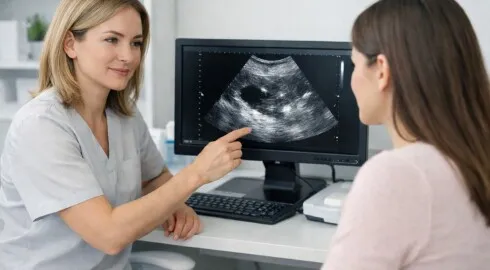
In many cases, an in-person examination, clarification of symptoms, and an ultrasound are enough for the doctor to understand whether the situation still fits the expected logic of the cycle or already requires a more careful evaluation. Not every severe pain means a serious problem, but not every severe pain deserves automatic reassurance either.
Clinical Example: When “Just Painful Periods” Stopped Being Just Painful Periods
A 29-year-old woman presented with a complaint of very painful periods on the first day: previously, her cycle had always involved moderate pain, but in recent months the first day had become much harder to get through – with marked cramping, weakness, and the need to completely cancel normal daily activities. Her usual pain relief still helped, but no longer as well as before.
After examination and additional diagnostics, we assessed the situation not as “just another difficult cycle,” but as a change in the usual pattern. In such cases, what matters most for the doctor is not simply relieving yet another painful episode, but understanding why the pain has stopped being typical for this particular woman and at what point a usual menstrual response shifted into a clinically more significant problem.
Frequently Asked Questions from Patients
If Periods Are Very Painful Only on the First Day, Can That Still Be a Normal Variant?
Sometimes – yes, but only if this pattern has been familiar for a long time, is not getting worse over time, is not accompanied by atypical symptoms, and overall remains predictable. The first day really often is the hardest by itself. But if the first day has started to feel significantly worse than before, or if the pain disrupts life too severely, that is already a reason not to reassure yourself automatically.
If My Periods Used to Be Tolerable but Have Now Become “Unbearably Painful,” Does That Always Mean Something Serious?
Not necessarily, but it always deserves closer attention. For a doctor, a sudden increase in pain matters more than pain itself. Sometimes the cause turns out to be non-dangerous and treatable, but a change in the usual pattern is still something that should not be left without evaluation.
If the First Period After an Abortion Is Very Painful, Is That Always a Complication?
No, not always. The first period after an abortion can genuinely be harder to get through. But if the pain is too severe, atypical, responds poorly to the usual pain relief, or is accompanied by fever, an unpleasant odor of discharge, marked weakness, or unusual bleeding, that is no longer the kind of situation where it is better to simply wait it out.
If Painkillers Help, Does That Mean Everything Is Fine?
Not necessarily. Pain relief can temporarily ease even a situation that already requires attention. For a doctor, what matters is not only whether the medication helps, but whether it has to be used more often than before, whether its effectiveness is declining, and whether the nature of the pain itself is changing from cycle to cycle.
When Very Painful Periods Stop Being Just “A Feature of the Cycle”
The most common mistake with this complaint is waiting for the pain to “explain itself” over time. But severe menstrual pain rarely becomes clearer just because you wait. It is much more useful to rely not on general fear, but on simple clinical logic: if the pain behaves in a familiar way, that is one scenario; if it has become different, stronger, heavier, or is accompanied by atypical signs, that is already another.
When periods stop feeling like an unpleasant but familiar day of the cycle and start feeling like something you have to prepare for in advance with anxiety, that is exactly the moment when the question should move from “just get through it” to “figure it out.”
If the pain has become too severe, has changed compared with previous cycles, or raises concern, the most useful next step is not to keep trying to guess each time how “normal” it is, but to calmly understand once and for all why the body is reacting this heavily and where the line lies between a typical spasm and a situation that already requires a different clinical approach.




Clinical Guidelines and References
- ACOG – Dysmenorrhea and Endometriosis in the Adolescent / guidance on evaluation of painful menstruation.
- NICE – Heavy menstrual bleeding and related pelvic symptom assessment principles.
- ESHRE Guideline – Endometriosis.
- FIGO – good clinical practice considerations for menstrual pain and abnormal uterine symptoms.