



If you are reading this material, then most likely you are dealing not with an abstract fear, but with a very specific problem. Either a stone was found earlier, or you have already had pain in the lower abdomen or in the kidney area, or an ultrasound/CT scan showed that the stone has “started moving” or is “stuck in the ureter.” And in such a situation, the main question is usually very simple: can it still come out on its own, or is this already the kind of situation where waiting becomes dangerous?
Can a Ureteral Stone Pass on Its Own
Let me say the main thing right away. Yes, a ureteral stone can sometimes indeed pass on its own. But that is not the answer that actually helps the patient. Because after that “can,” the patient immediately has a second question: in my situation, does this still look like a normal spontaneous passage, or not anymore?
How Long Can a Ureteral Stone Take to Pass
It is widely accepted in urological practice that kidney stones up to 7 mm in size may pass spontaneously (Glybochko P.V., 2012). Once the urologist prescribes a standard medical expulsive therapy regimen, the waiting begins for when the patient will finally “deliver” that nasty little stone. In the end, they wait a day, two days, a week, a month, and so on. Meanwhile, recurrent attacks may occur, accompanied by symptoms the patient already knows all too well.
And this is where the most unpleasant practical question arises: which urologist can tell a particular patient exactly when the stone will come out? After all, the diameter of the ureter at its narrowest point – the intramural segment – is 2–3 mm, while we somehow expect a 5–7 mm stone to pass through it. Yes, in most cases, such stones do indeed pass on their own. But the real question is different: how is the patient supposed to know whether they will be among that fortunate “majority,” how long they are supposed to wait, and how long they are expected to keep suffering during that time?
According to data from international authors (Preminger G.M., 2007; Miller O.F., 1999), the probability of spontaneous passage of ureteral stones smaller than 5 mm is 68%, while for stones larger than 5 mm it is 47%. The average time for spontaneous passage is 31 days for stones up to 2 mm, 40 days for 2–4 mm stones, and 39 days for stones larger than 4–6 mm. Just think about those numbers!
What Really Determines Whether the Stone Will Pass on Its Own
Patients love looking for a “cutoff number”: up to 5 mm – it will pass, 6 mm – it will not. In real urology, stone size alone does not provide a definitive prognosis.
Yes, smaller stones – roughly up to 5 mm – do on average pass on their own more often than larger ones. Yes, stones measuring 5–6 mm are already noticeably less predictable. Yes, anything larger more often becomes a problem rather than a situation for calm waiting. But this is not a rigid law. A 4 mm stone can create a serious situation if it gets stuck in an unfortunate place, causes significant spasm, and obstructs urine flow. A 6 mm stone may still pass if the anatomy allows it and the ureter “lets go.” So the number is a guideline, not a verdict and not a guarantee.
If the stone is already in the ureter, then not only its size matters. What matters is the level where it is located, the severity of spasm, swelling of the ureteral wall, whether urine outflow is preserved, how the pain behaves, and whether there are signs of inflammation. That is why in one situation a doctor may allow time, and in another – may not, even if the number in millimeters seems “small.”
A separate note about searches like “in men” and “in women.” People often search this in everyday life, but in real urology, sex itself is not what determines the situation. In other words, the question is not whether you are a man or a woman. The question is what this stone is currently doing to the ureter and the kidney.
What a Stone Usually Feels Like When It Moves Through the Ureter
This is where that unpleasant phase begins – the one patients tend to remember for a long time. When a stone is sitting in the kidney, it may go a long time without causing a vivid clinical picture. But when it starts moving into the ureter, the scenario often changes abruptly. At that point, the stone is no longer just “there” – it is interfering with urine flow and provoking spasm.
How it usually feels:
- pain in the lower back or side;
- the pain may radiate lower – to the side of the abdomen, lower abdomen, or groin;
- in men, the pain may radiate to the testicle;
- in women, it may feel like lower abdominal pain or “like a gynecological issue,” which can sometimes be misleading;
- there may be nausea, sometimes vomiting;
- frequent urination, burning, or false urges may appear;
- there may be blood in the urine – from pinkish to clearly red;
- the pain may come in waves: it eases off, then hits again.
And here is an important point that patients often misunderstand: if the pain eases, that does not mean the stone has passed. The pain may lessen because the spasm temporarily eased, after taking painkillers, because the stone shifted slightly but is still inside, or because the pressure changed even though the problem itself has not been resolved. In other words, relief is good for how you feel. But it is not proof that the situation has become safe.
Why “Speeding It Up” or “Forcing the Stone Through the Ureter” Is a Bad Idea
This is one of the most dangerous everyday approaches. The patient wants to do at least something. And then it starts:
- “jump around so it moves”;
- “run up and down the stairs”;
- “drink a lot of water and force it through”;
- “heat up really well so everything relaxes”;
- “take everything people recommend on forums.”
It is especially dangerous when a person starts forcing large amounts of fluid into themselves against a background of severe pain and already impaired urine outflow. In everyday thinking, it seems like: “it needs to be flushed out.” In practice, this may only increase the pressure above the blockage and make things worse. The problem is that you cannot see the real picture. You do not know whether the stone is blocking partially or completely, how severe the spasm is, whether there is already dilation above it, whether inflammation is already starting, and whether you are making things worse instead of “speeding it up.” That is exactly why trying to “push” a stone through at home is dangerous and unpredictable. You are not pushing a ball through a pipe. You are dealing with living tissue, a spasming ureter, pain, the risk of blockage, and sometimes the risk of infection.
What Changes If the Stone Gets Stuck in the Ureter
This is where the relatively safe scenario ends – the one in which there is still some hope that the stone may simply pass on its own. While it is moving, the situation is unpleasant, but sometimes it still remains within the boundaries of observation. When the stone gets stuck, the logic changes. This is no longer a story of “wait a little longer,” but a story of the ureter no longer allowing urine to pass normally, while the kidney above the obstruction starts functioning under abnormal conditions.
The word “stuck” sounds casual, but its meaning is very specific. The stone has not just been delayed. It has either stopped moving normally, or is moving so poorly that a safe spontaneous passage is already in doubt. And this is where patients most often make the same mistake: they judge the situation by the intensity of the pain. If it gets weaker, they think the stone is probably moving. If there are breaks between attacks, they think it can still be tolerated. In urology, that is unreliable logic.
Which Signs Mean Safe Waiting Is Over
There is no single “magic” sign after which you can honestly say: that is it, this is definitely no longer a spontaneous passage. Usually, it is a combination of several things, and what needs to be assessed is not one symptom, but the overall picture.
What you should look at first:
- the pain lasts too long or keeps returning again and again without a proper symptom-free interval;
- painkillers help only slightly, only briefly, or are almost no longer helping at all;
- the pain becomes not just severe, but exhausting;
- burning, frequent urges, or the feeling that “you constantly need to urinate” appear or worsen, but there is no relief;
- the amount of urine becomes noticeably smaller;
- there is a feeling that urination has become strange, difficult, or “not normal”;
- blood in the urine is not a one-time episode, but continues;
- against the background of pain, the overall condition clearly starts to break down – weakness, nausea, vomiting, feeling generally unwell;
- fever or chills appear.
Here it is important to understand one unpleasant but very useful thing: less pain does not always mean the stone has passed, or even that it is moving properly. The stone may shift slightly, temporarily reduce the spasm, change the pressure in the ureter – and against that background the patient feels like “it is getting better.” But that does not always mean the situation has become safer.
So the key question here is not “does it hurt more or less right now.” The key question is different: are there signs that the stone has stopped being just a painful episode and has started to disrupt normal urine outflow, the overall condition, and the very logic of safe waiting.
An especially alarming combination is a stone, reduced urine output, and fever or chills. This is no longer an everyday story of “the little stone is moving.” This is a situation where the risk concerns not only the pain, but also the kidney and inflammation. If the picture starts to develop in this direction, options like “wait until tomorrow,” “until Monday,” or “a couple more days, maybe it will still pass” are no longer acceptable. At that point, the task is no longer to endure, but to understand how pronounced the outflow obstruction is and whether the situation is starting to move into a complicated phase.
Frequently Asked Questions About Ureteral Stones
Can You Use Heat for a Ureteral Stone?
Heat really can temporarily reduce spasm and make the pain less severe. That is why some patients start feeling that a heating pad is almost a form of treatment. No. At best, it is only temporary relief, and not always even that.
If there is fever, chills, a pronounced deterioration in general condition, or you do not understand what is happening at all, heat should not be used.
And most importantly: even if heat makes you feel better, that does not mean the stone is “moving the way it should.” A heating pad does not answer the question of whether the stone has passed or whether the kidney is under strain.
Can a Ureteral Stone Be Seen on Ultrasound?
Sometimes – yes. But not always.
This is a very important point. Patients often think like this: “I had an ultrasound, they didn’t see the stone, so it probably passed.” No. Not necessarily.
Ultrasound may show the stone itself. It may show indirect signs – for example, dilation above the obstruction. It may provide useful initial information. But ultrasound has limitations. A ureteral stone is not always clearly visualized. This is especially true if bowel gas interferes, the location is unfavorable, the stone is small, or body habitus creates technical limitations.
That is why in real urology it is sometimes more important not simply whether “they saw the stone or not,” but whether there are signs that urine above it is not draining properly and the kidney is working under pressure. And in some cases, ultrasound alone is not enough.
What If a Stone Gets Stuck in the Ureter During Pregnancy?
During pregnancy, this is a situation where self-treatment is especially dangerous.
The issue is no longer only pain. What matters here is the mother’s condition, safe diagnostics, the risks of dehydration, the risk of infection, and a management plan that is safe for pregnancy. If there is suspicion that a ureteral stone is truly stuck during pregnancy, this requires in-person medical assessment, not home improvisation.
Can You Help Yourself With Medicines or Folk Remedies for Ureteral Stones?
The most honest wording is this: sometimes it is possible to partially relieve how you feel, but it is far from always possible to solve the problem safely at home. This is exactly where patients most often confuse relieving a symptom with solving the situation. You may reduce the pain for a while. You may lessen the spasm temporarily. You may gain a few hours of relative relief. But that does not mean the stone has passed, the outflow has been restored, the kidney is safe, and there is no risk of infection.
As for “folk remedies,” diuretic herbs, mixtures meant to “speed things up,” and aggressive fluid intake “to flush it out” – there is a lot of harmful advice here. Against the background of an already problematic stone passage, all of this may intensify the pain, increase the pressure above the obstruction, blur the clinical picture, and delay the moment when proper evaluation was already needed.
What the Patient Must Not Miss in This Situation
In short, here is the main point of the entire article. A ureteral stone is not the kind of situation where safety can be judged honestly by sensations alone. Yes, a stone sometimes passes on its own. Yes, not every case immediately ends in intervention. Yes, not every pain episode is a catastrophe. But there is one mistake patients make again and again: they try to decide everything by everyday logic.
- The pain became weaker – so it must be better.
- The stone is small – so it will pass.
- There is no fever – so it is safe to wait.
- It was not seen on ultrasound – so it must already be gone.
These conclusions often turn out to be false.
In reality, the right questions sound different:
- can the stone still truly pass on its own, or not anymore;
- is urine outflow impaired;
- is the kidney starting to suffer;
- has inflammation developed;
- is it still safe to observe.
If you suspect that the stone is already in the ureter, and especially if the pain keeps recurring, does not resolve properly, or is changing in a bad direction, it is not worth delaying an in-person evaluation by a urologist. What matters here is not simply to “get through the attack,” but to understand what is happening to the ureter and kidney right now. Because in this topic, the problem is not only that “it hurts badly.” The problem is that for too long it may seem as if waiting is still possible.


A Kidney Stone Does Not Hurt – When It Can Be Observed and When Waiting Becomes Dangerous
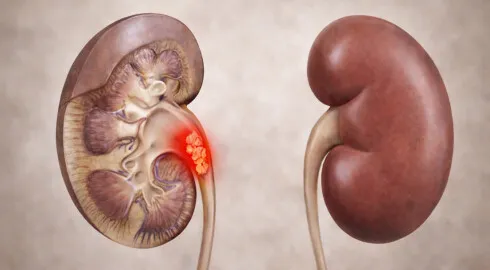
Renal Colic – Key Symptoms and Causes, How to Provide First Aid

Bladder Stone – What Symptoms It Can Cause, When It May Pass on Its Own, and Why the Problem Is Often Not Just the Stone Itself

Clinical Guidelines and References
- EAU Guidelines on Urolithiasis. European Association of Urology – latest edition.
- Türk C. et al. EAU Guidelines on Diagnosis and Conservative Management of Urolithiasis. European Urology.
- Skolarikos A. et al. Metabolic Evaluation and Recurrence Prevention for Urinary Stone Disease. European Urology.
- Preminger G.M. et al. Guideline for the Management of Ureteral Calculi. Journal of Urology.
- Miller O.F., Kane C.J. Time to Stone Passage for Observed Ureteral Calculi. Journal of Urology.
- UpToDate. Nephrolithiasis in Adults: Pathogenesis, Clinical Features, and Diagnosis.
- National Institute for Health and Care Excellence (NICE). Renal and Ureteric Stones – Assessment and Management.